


Views: 0 Author: Site Editor Publish Time: 2026-04-23 Origin: Site


Every growing textile business eventually hits a production wall. You transition from bespoke runs to larger wholesale orders. Suddenly, your manual cutting department becomes a massive bottleneck. Scissors and manual rotary blades slow down your entire production line. They create expensive material waste. They also cause severe operator fatigue. Joint pain among workers translates directly to inconsistent cuts. These minor inaccuracies cascade into the sewing department, forcing sewers to artificially stretch or gather fabric. Eventually, these bottlenecks scale into massive profit losses. To fix this, you must upgrade your equipment. However, selecting the right Fabric Cutting Machine is not just about raw speed. You need to carefully align the physical cutting mechanism with your specific fabric properties. You must consider whether a blade, laser, water jet, or sound wave fits your material best. You also must account for your daily production volumes. In this guide, we explore the distinct categories of cutting equipment. You will learn how to evaluate success criteria, compare semi-automatic workhorses, and understand the ROI behind automated industrial systems.
Semi-automatic machines (straight, round, and band knives) balance affordability with high-ply capacity but require skilled operators.
An automatic fabric cutting machine (CNC oscillating knife or laser) maximizes material yield via auto-nesting software but requires significant upfront investment and digital pattern reliance.
Thermal cutting (lasers, hot knives) naturally seals synthetic edges to prevent fraying, while cold cutting (oscillating blades, water jets) prevents burning on natural fibers.
Even highly automated production floors still rely on manual industrial shears for on-the-fly adjustments and touch-ups.
Framing the Bottleneck: Manual cutting processes rely heavily on hand-held rotary cutters and industrial scissors. This inherently introduces human error into your daily workflow. It severely limits your ply height. Operators simply cannot push physical scissors through twenty layers of heavy denim. As you scale production, these manual processes create severe ergonomic risks. Repetitive strain injuries, such as carpal tunnel, spike among your floor workers. This slows down output and increases costly downtime.
Success Criteria for Upgrading: When evaluating a new equipment purchase, you must look beyond the initial price tag. Upgrading your floor requires a strategic approach. Use these three core criteria to measure success:
Throughput: You need the ability to cut multiple plies simultaneously. The machine must accomplish this multi-layer task without blade deflection. If a blade deflects, it ruins the bottom layers of your stack.
Yield: You must reduce fabric waste. High-end systems achieve this through tighter pattern placement. They squeeze every usable inch out of expensive raw materials.
Edge Quality: The tool must eliminate fraying, fusing, or physical distortion. It must leave a pristine edge ready for immediate sewing.
Overview: These motor-driven tools provide raw mechanical power. However, they still require manual guidance from a trained operator. They act as the ideal middle ground for mid-sized production lines. They balance speed, affordability, and daily flexibility.
Mechanism: A straight knife machine uses a vertical reciprocating blade. A powerful electric motor pushes this blade up and down rapidly. The operator pushes the entire unit through heavy fabric stacks.
Pros: They are highly versatile. You will find them excellent for navigating large curves. They slice easily through very thick plies. They also offer a remarkably low cost of entry for growing clothing brands.
Implementation Risk: You must watch out for costly operator error. The heavy motor sits directly above the blade mechanism. In unskilled hands, this top-heavy weight causes the blade to tilt. This deflection creates serious dimensional errors on the bottom fabric layers. Operators should always wear metal mesh safety gloves when handling these powerful reciprocating blades.
Mechanism: Round knife machines operate using a rapidly rotating circular blade. They feature a flat, polished baseplate. Operators slide this baseplate under the fabric stack.
Pros: They slice cleanly through flat textiles. They operate roughly ten times faster than straight knives. This high speed makes them perfect for long, straight cuts. They also handle very gentle curves with ease.
Cons: They severely lack maneuverability. You cannot use them for tight curves. They fail on sharp corners. They are also unsuitable for ultra-thick plies, as the circular metal hub obstructs deep fabric stacks.
Mechanism: A band knife operates as a large stationary machine. It looks very similar to a woodworker's band saw. Instead of pushing the tool through the fabric, the operator maneuvers the fabric into the continuous vertical blade.
Pros: They provide ultimate precision for small garment components. You can cut collars, cuffs, and intricate patterns perfectly. The stationary setup provides unmatched stability.
Operational Tip: Industrial units often utilize specialized air-blower tables. These tables create an upward air flotation effect. This air cushion drastically reduces physical friction. It neutralizes the fabric weight while operators maneuver heavy stacks, significantly reducing workplace fatigue.
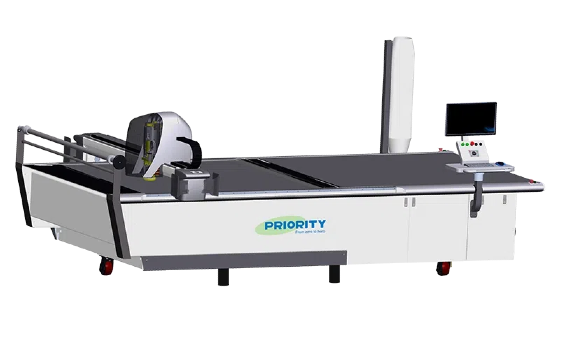
Overview: Computer-controlled (CNC) systems define modern mass production. These machines remove the operator from the physical cutting process entirely. You simply load the materials. The computer handles the entire toolpath. This digital shift maximizes raw output.
Mechanism: These systems use high-frequency vertical blade vibration. They pair this rapid sawing motion alongside a powerful vacuum suction table. The vacuum pulls downward. It clamps the fabric stack firmly in place without physical weights.
Pros: An Automatic Fabric Cutting Machine utilizing an oscillating knife provides a true "cold cut." It produces no harsh odors. It causes no scorch marks. They are excellent for leather, wool, and heavy multi-layer flexible materials. Crucially, they integrate seamlessly with CAD-driven auto-nesting software. This integration maximizes your material yield by calculating the tightest possible pattern placements.
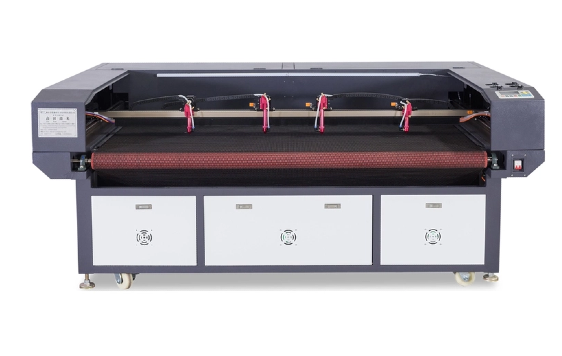
Mechanism: A laser cutter utilizes a focused CO2 laser beam. It literally melts or vaporizes the fabric along the precise digital cut path.
Pros: This provides zero mechanical stress. The lack of physical contact prevents fabric distortion entirely. Furthermore, the heat naturally seals the edges of synthetic fabrics. This melting action completely prevents future fraying.
Cons: You cannot use lasers for multi-ply cutting of synthetics. The intense heat will fuse the stacked layers together into a solid, unusable block. Additionally, lasers are generally unsuitable for natural fabrics like cotton or linen. These natural fibers are highly prone to ugly scorching. You must also install robust fume extraction systems to handle toxic smoke.
Water Jet: Water jet technology uses an ultra-high-pressure stream of water. It exerts zero thermal stress. This makes it ideal for extremely soft, shape-shifting fabrics like silk and loose wool.
Risk: When cutting very thick plies, the water stream can dissipate near the bottom layer. This dissipation causes uneven, beveled, or slanted edge cuts.
Ultrasonic: Ultrasonic cutters use high-frequency sound waves. They cut and seal the material simultaneously using sonic friction. This represents the absolute industry standard for high-sanitation medical textiles. They leave pristine, sealed edges on technical materials without burning.
Not every project requires a massive industrial setup. Small studios, prototyping labs, and bespoke tailors rely heavily on specialized desktop and manual tools.
Mechanism: These machines use physical steel-rule dies. A heavy mechanical press stamps these metal templates out of the fabric under extreme pressure.
Use Case: They excel at high-volume, exact-repeat shapes. Think of standard quilting squares or identical leather patches. A die cutter can be up to 90% faster than manual rotary cutting. However, it requires very high upfront tooling costs for each unique shape you design.
Use Case: Desktop plotters are excellent for custom applique. They work perfectly for initial prototyping. You also use them for single-ply customized cutting. They are highly versatile. You can swap blades to cut vinyl, paper, and light fabrics. However, they are completely unsuited for commercial multi-ply scaling due to blade drag issues.
Hot Knives: These are essential handheld tools. You must use them for marine canvas, outdoor awnings, and heavy synthetics. The heated blade cuts and melts the plastic fibers simultaneously. This instantly prevents edge unraveling. Proper ventilation is mandatory when using hot knives.
Pinking Shears: These specialty scissors create physical zigzag cuts. They mitigate fraying on light-to-medium wovens. You use them when heat sealing simply isn't an option for natural fibers.
Choosing your equipment requires a highly structured approach. You must map your specific materials to the right technology. You must also calculate the total financial impact.
Use this summary chart to align your textile types to the optimal cutting method. Applying the wrong machine to a fabric will cause immense waste.
Material Profile | Recommended Machine Type | Primary Benefit |
|---|---|---|
Heavy-duty / Canvas | Straight knives, heavy-duty rotary | High-ply penetration, raw mechanical power |
Synthetics / Nylon | Laser, Hot knife (for edge sealing) | Automatic edge sealing to prevent fraying |
Medical / Cleanroom | Ultrasonic | High-sanitation, fray-free cutting |
High-Ply Wovens | CNC Oscillating, Straight Knife | Maintains structural integrity across thick stacks |
Transitioning to a fully automatic fabric cutting machine is not seamless. It requires specialized maintenance personnel. You must train your staff on new software. You also become entirely reliant on digital pattern files. This digital reliance severely limits "on-the-fly" floor modifications. If an operator spots a pattern issue, they cannot simply grab shears and adjust it mid-run. Manual or semi-automatic setups offer much greater impromptu flexibility. You trade spontaneity for rigid, high-speed precision.
Selecting a cutting system requires a delicate balancing act. You must weigh your ply depth against your fabric properties. You must compare synthetic melting behaviors against natural fiber burning risks. Finally, you must align these factors with your daily production volume to ensure true profitability.
We recommend buyers take actionable next steps before signing a purchase order. Always conduct a "test cut." Send scrap material from your actual production line to the equipment manufacturer. Let them prove their machine handles your specific textile. Finally, audit your current fabric waste percentage. This concrete data will clearly justify whether you are ready to make the jump to full CNC automation.
A: Laser cutters and handheld hot knives are best for synthetic materials because they melt and seal the edge. For natural fibers, ultrasonic cutters or manual pinking shears are preferred.
A: CNC oscillating knives handle multi-layer synthetics perfectly. Laser cutters, however, can cause multi-layer synthetics to melt and fuse together, requiring single-ply or low-ply processing.
A: Straight knives cut thicker stacks (high plies) and navigate curves better. Round knives operate at faster speeds but are limited to straight lines, gentle curves, and shorter fabric stacks.


