


Views: 0 Author: Site Editor Publish Time: 2026-05-06 Origin: Site


Walk into any traditional garment factory, and you will quickly spot a major production bottleneck. You often see two to six operators manually pulling heavy textile rolls down long tables. This outdated manual process causes severe tension inconsistencies. It slows down daily output drastically. It also generates massive amounts of fabric waste. When workers stretch materials during manual pulling, the fabric inevitably shrinks back after cutting. This ruins the final garment dimensions.
Modern automation solves these exact problems. The solution is the fabric spreading machine. This equipment bridges the gap between raw inventory and the active cutting room. Manufacturers engineer these automated systems to unroll, align, and stack fabric layers with mathematical precision.
This guide serves as a decision-stage resource for operations managers and procurement teams. We will bypass basic definitions. Instead, we explore technical capabilities, integration realities, and expected efficiency returns. You will learn exactly how to evaluate your next equipment upgrade.
A fabric spreading machine automates the unrolling and layering of textiles on a cutting table, ensuring perfect edge alignment and zero-tension laying.
Equipment tiers range from basic manual setups (sub-60kg limits) to fully automated, software-driven systems capable of handling 300kg rolls at speeds up to 90 meters per minute.
Selecting the right machine depends heavily on material type (directional vs. symmetrical) and the required spreading method (One-way vs. Zigzag).
Modern ROI is driven not just by speed, but by advanced features like Job File integration for automated splicing, and LiDar sensors for workplace safety.
To truly understand what is a fabric spreading machine, we must examine its mechanical transition from manual labor to automated precision. The baseline function is straightforward but critical. A motorized carriage travels back and forth along a lengthy cutting table. As it moves, it unrolls and deposits highly accurate, stacked layers of fabric. Industry professionals call this stacked material the "lay." Once the machine completes the lay, the fabric is perfectly prepped for pattern cutting.
Achieving a "tension-free" lay remains the ultimate gold standard in the textile industry. Fabric inherently stretches when pulled. If a machine or human operator applies too much tension, the fabric stays temporarily elongated on the table. You cut the patterns. Then, the fabric relaxes and shrinks back to its natural state. Your cut pieces suddenly become undersized. You must scrap the entire batch.
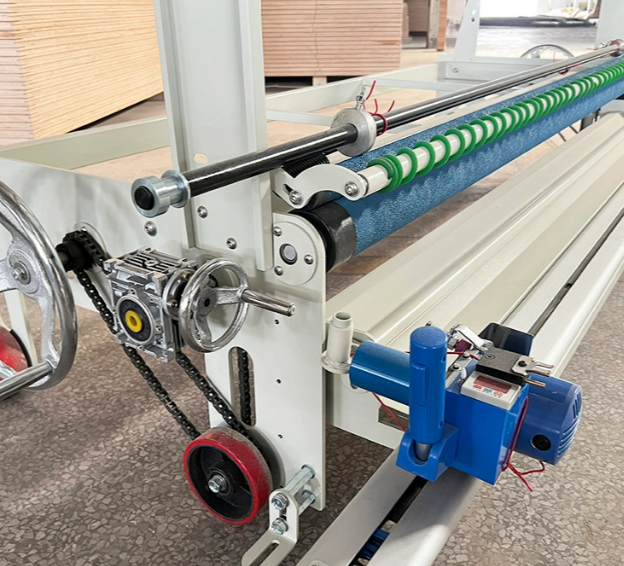
Advanced machines prevent this disaster using motorized dancer bars and synchronized feed rollers. The feed rollers actively unspool the material at the exact speed the machine travels down the table. The lightweight dancer bar monitors the fabric loop continuously. It adjusts the feed motor instantly to ensure the fabric drops onto the table under its own weight, completely tension-free.
Lateral fabric waste eats into profit margins silently. Traditional manual spreading leaves jagged, uneven edges. Workers must trim these away later. Modern equipment eliminates this through precise edge alignment systems.
The machine uses photoelectric sensors, commonly called the "electric eye." These sensors shoot a continuous beam to monitor the fabric edge as it unwinds. If the roll shifts even slightly, the sensor detects the deviation. It sends an immediate signal to a rapid servo motor. The motor shifts the entire cradle laterally to correct the path. This guarantees a perfectly straight edge across hundreds of layers. You save thousands of yards of material annually.
You cannot use a one-size-fits-all approach when evaluating spreading machines. Different textiles demand completely different operational modes. Choosing the wrong method causes severe pattern shading or misalignment.
Spreading Method | Mechanics | Best For | Business Value |
|---|---|---|---|
Zigzag (Face-to-Face) | Lays fabric continuously in both directions across the table. | Symmetrical materials with no distinct front or back differences. | Maximum speed and efficiency for high-volume mass production. |
One-Way (Face One Way) | Lays fabric in one direction, then travels back empty (dead-heading). | Directional patterns, velvet, corduroy, specific nap directions. | Eliminates pattern misalignment and shading defects at the cost of speed. |
Multiple-Length | Lays varying lengths and ply counts in different table sections. | High-mix, low-volume orders, and remnant utilization. | Maximizes flexibility for custom orders and reduces dead-stock waste. |
In Zigzag mode, the machine lays fabric continuously as it moves in both directions. It folds the material at each end without cutting it. We primarily use this method for symmetrical materials. These fabrics show no distinct difference between the face and the back. Fast-fashion manufacturers love Zigzag spreading. It is incredibly fast. It minimizes travel time and maximizes high-volume mass production output.
One-way spreading demands more time but ensures strict quality control. The machine lays the fabric in a single direction. Once it reaches the end, an automatic knife cuts the ply. The carriage then dead-heads—traveling empty back to the starting position.
You strictly need this method for directional patterns, velvet, and corduroy. These fabrics have a specific nap direction. If you lay them face-to-face, light hits the garment panels differently. This causes disastrous shading defects on the finished product. One-way spreading sacrifices raw speed to completely eliminate these costly visual defects.
Modern factories often handle smaller, highly customized orders. Multiple-length spreading allows the machine to lay varying lengths and plies in different sections of the same cutting table. It creates "steps" of fabric. You use this method for high-mix, low-volume orders. It also provides an excellent way to utilize fabric remnants. It transforms leftover material into usable lays instead of throwing it in the trash.
Evaluating your current operational maturity helps you identify the correct upgrade path. Equipment ranges from simple mechanical aids to highly sophisticated digital systems.
Manual & Entry-Level Systems:
These basic setups typically limit you to lightweight rolls. They usually max out at 60kg in weight and 50cm in diameter. They rely heavily on operator pacing. Workers physically push the carriage down the rails. The Shortcomings: You suffer from inconsistent tension across the lay. Operators experience high physical fatigue. You still risk significant ergonomic strain.
Semi-Automatic Machines:
This tier introduces essential motorized drives and basic edge-sensing technology. The machine propels itself down the table. It aligns the edges automatically. However, operators must manually cut the fabric at the end of each one-way ply. The Reality: It drastically improves overall edge consistency compared to purely manual racks. It serves well as a transitional step for mid-sized factories.
Fully Automated High-End Systems:
These machines handle massive, heavy-duty rolls weighing up to 300kg. They feature dynamic speed controls pushing up to 90 meters per minute. They include automatic end-cutting devices and programmable ply counters. The Reality: They feature ergonomic cradle lifting systems. The cradle lowers completely to the floor or trolley height. Workers simply roll the fabric in. This eliminates heavy manual lifting completely.
What to watch out for: Do not buy a fully automated 300kg machine if your warehouse currently lacks the forklifts or specialized trolleys required to transport rolls of that size to the cutting room. Always match the equipment tier to your existing facility infrastructure.
Speed alone does not justify major capital expenditures. Today, software integration and safety subsystems drive the true return on investment. They reduce expensive errors and protect your workforce.
Modern factories do not operate in silos. High-end equipment reads CAD and marker data directly through digital Job Files. The machine software understands the exact length and composition of the incoming lay.
The system predicts roll run-outs intelligently. It calculates the exact splice locations needed to save fabric. Instead of an operator guessing where to overlap a new roll, the machine dictates the mathematically perfect spot. It also logs precise meterage data for production analytics. You gain complete visibility into actual material consumption versus planned usage.
Safety features protect operators and prevent costly production halts. Look for equipment featuring LiDar multi-zone safety sensors. These laser sensors map the area around the moving carriage. If an operator steps into the travel path, the machine automatically slows down. If the operator gets too close, the machine stops instantly.
Automated blade enclosures keep sharp end-cutters safely hidden until the exact moment of cutting. Furthermore, specialized double-roll trolleys eliminate dangerous pinch points during roll loading. They protect worker hands and backs, ensuring a safer factory floor.
Standard features handle basic cotton perfectly, but specialty fabrics require specialty attachments. Consider these material-specific subsystems:
De-creasing rollers: These expanding rollers smooth out hard wrinkles in woven fabrics before they hit the table.
Tubular knit deflectors: Tubular knits often suffer from edge creases. Specialized deflectors open and flatten the tube perfectly without stressing the center fold.
Vibrating plates: These plates gently agitate highly static or sticky materials, helping them release smoothly onto the lay.
You need a skeptical, evidence-based approach when evaluating vendors. Use the framework below to separate marketing claims from operational realities.
Evaluation Criteria | What to Investigate | Red Flags to Avoid |
|---|---|---|
Payload & Footprint | Match the cradle capacity (e.g., 100kg vs. 300kg) to actual supply chain realities. Measure space for extended air-cushion tables. | Buying a 300kg machine without proper loading trolleys or floor space. |
Software Interoperability | Ensure operating software can ingest marker files seamlessly from your existing CAD suite. | Siloed, proprietary software requiring manual data entry for every lay. |
Operator Adoption Curve | Test the User Interface (UI). Look for visual icons, color touchscreens, and virtual throttles. | Complex button arrays requiring weeks of legacy operator training. |
Tensionless Verification | Request live test runs using your most difficult, highly elastic spandex fabrics. | Vendors refusing live tests on your specific problem materials. |
Always ground your purchase in physical reality. If your suppliers deliver 100kg rolls, buying a 300kg cradle wastes money. Additionally, automated setups require specialized tables. You must factor in the physical space needed for extended air-cushion tables or conveyorized systems. These tables take up significantly more floor space than basic wooden racks.
Siloed systems destroy efficiency. Your new machine must talk to your old software. Ensure the operating system ingests standard ISO or DXF marker files from your existing CAD suite. If operators must manually type lay lengths into the machine screen every morning, you lose the primary benefit of digital integration.
Factory turnover is a reality. You cannot rely solely on legacy skilled labor. Evaluate the User Interface (UI) carefully. The best machines use intuitive color touchscreens. They employ "virtual throttles"—simple digital sliders that control speed dynamically. An intuitive UI lowers the training barrier. New operators can learn to run the system safely in a single afternoon.
Every manufacturer claims their machine lays fabric without tension. You must verify this independently. Advise your purchasing team to request a live test run. Send the vendor your most difficult, highly elastic fabric blends. Measure the cut pieces 24 hours later. This proves the manufacturer's tension-free capabilities definitively before you sign a purchase order.
Upgrading your cutting room infrastructure transforms your entire production timeline. The transition from manual unrolling to automated laying immediately standardizes your output quality.
Quality Asset: Treat this equipment not just as a speed upgrade, but as a mandatory quality control and waste reduction asset.
Targeted Capabilities: Match your purchase strictly to your dominant material types, ensuring your chosen spreading method prevents pattern shading.
Digital Safety: Leverage modern features like Job File integration and LiDar sensors to protect both your material margins and your human workforce.
Next Steps: Conduct a comprehensive time-and-waste audit of your current manual processes this week. Then, request a live material test from a trusted manufacturer. Use that exact data to build a concrete, undeniable business case for your leadership team.
A: High-end automatic machines can reach maximum speeds of up to 90 meters per minute. However, realistic operational speed depends heavily on the fabric type, thickness, and elasticity. Heavy denims tolerate faster speeds, while delicate silks or highly elastic knits require slower processing to maintain perfectly tension-free alignment.
A: Yes, many machines are versatile enough to handle both. However, tubular knits typically require specific machine variants or specialized attachments. You usually need specialized tubular deflectors and internal frames to prevent center creasing and edge rolling while the machine lays the material down.
A: It reduces waste through precise photoelectric edge alignment, which minimizes lateral trimming. It also features automatic end-cutting devices that slice exactly at the required length, eliminating manual over-cutting. Furthermore, software-driven splicing calculations determine the exact overlap point during roll changes, saving critical yards of fabric per job.


