

Views: 0 Author: Site Editor Publish Time: 2026-11-16 Origin: Site


If you have ever spent consecutive hours hunched over a sewing machine, you already understand the severe physical toll it takes on your cervical spine, lumbar region, and shoulders. The biomechanics of traditional textile work practically force the operator into a forward-leaning posture. Fortunately, a practical solution to this widespread occupational hazard is rapidly gaining traction across both home studios and commercial factory floors. Upgrading to a sewing elevator stand is completely revolutionizing how crafters and professional tailors interact with their equipment.
This comprehensive guide examines the mechanics, features, and operational advantages of height-adjustable sewing workstations. From analyzing the physiological benefits of a sit-stand configuration to selecting the appropriate heavy-duty equipment for commercial operations, we will help you navigate the technical specifications. Our goal is to ensure you make an informed purchasing decision that mitigates musculoskeletal strain while maintaining high operational efficiency.
Ergonomics is Key: A height-adjustable setup allows you to seamlessly switch between sitting and standing postures, drastically reducing lumbar fatigue and joint stiffness over long shifts.
Terminology Matters: An elevator stand acts as the motorized or mechanical base, providing the essential lifting power required to safely elevate heavy, vibrating textile equipment.
Home vs. Industrial Needs: While hobbyists might prioritize storage and fold-away designs, commercial setups require significantly higher weight capacities and advanced vibration control.
Crucial Buying Factors: Buyers must carefully evaluate lift motor torque, surface area flush-mounts, and lateral stability before investing to ensure the machine remains perfectly stationary.
Financial ROI: High-quality commercial stands yield a positive return on investment by reducing injury-related downtime and increasing worker output.
For decades, traditional sewing tables were little more than static, wooden cabinets. While these legacy structures offered built-in storage and a dedicated space for the machine, they forced the user to adapt their body to a rigid, fixed height. As production demands increased and industrial machines became substantially more powerful, the limitations of these static workstations became glaringly apparent, leading to widespread repetitive strain injuries. The modern transition to dynamic, ergonomic furniture reflects a broader industrial shift towards prioritizing occupational health and sustainable work practices.
At its foundation, this equipment is a specialized, heavy-duty adjustable base engineered specifically to manage the unique physical demands of textile manufacturing. Unlike standard office standing desks which only support lightweight monitors, a dedicated Sewing Elevator Stand is explicitly calibrated to handle the uneven weight distribution of heavy cast-iron machinery. Furthermore, these units are structurally reinforced with robust lifting columns and crossbar systems to absorb the high-frequency kinetic vibrations generated by industrial motors without compromising needle stability.
Early iterations of adjustable tables relied on manual hand-cranks or pneumatic gas cylinders. While functional, these manual systems disrupt the creative workflow and require unnecessary physical exertion, which can be dangerous when lifting heavy equipment. Consequently, contemporary professional environments have moved toward motorized electric systems. These units utilize advanced linear actuators to adjust the platform height smoothly at the push of a button, ensuring precision elevation without disturbing delicate fabric alignments.
The biomechanics of traditional sewing involve prolonged periods of cervical flexion and shoulder protraction. This unnatural posture, often called the sewing hunch, compresses spinal discs and overextends the trapezius muscles. A height-adjustable table directly counters this physiological stress. By bringing the work surface up to the operator's natural eye level, the desk promotes a neutral spine alignment and dramatically relieves cervical tension.
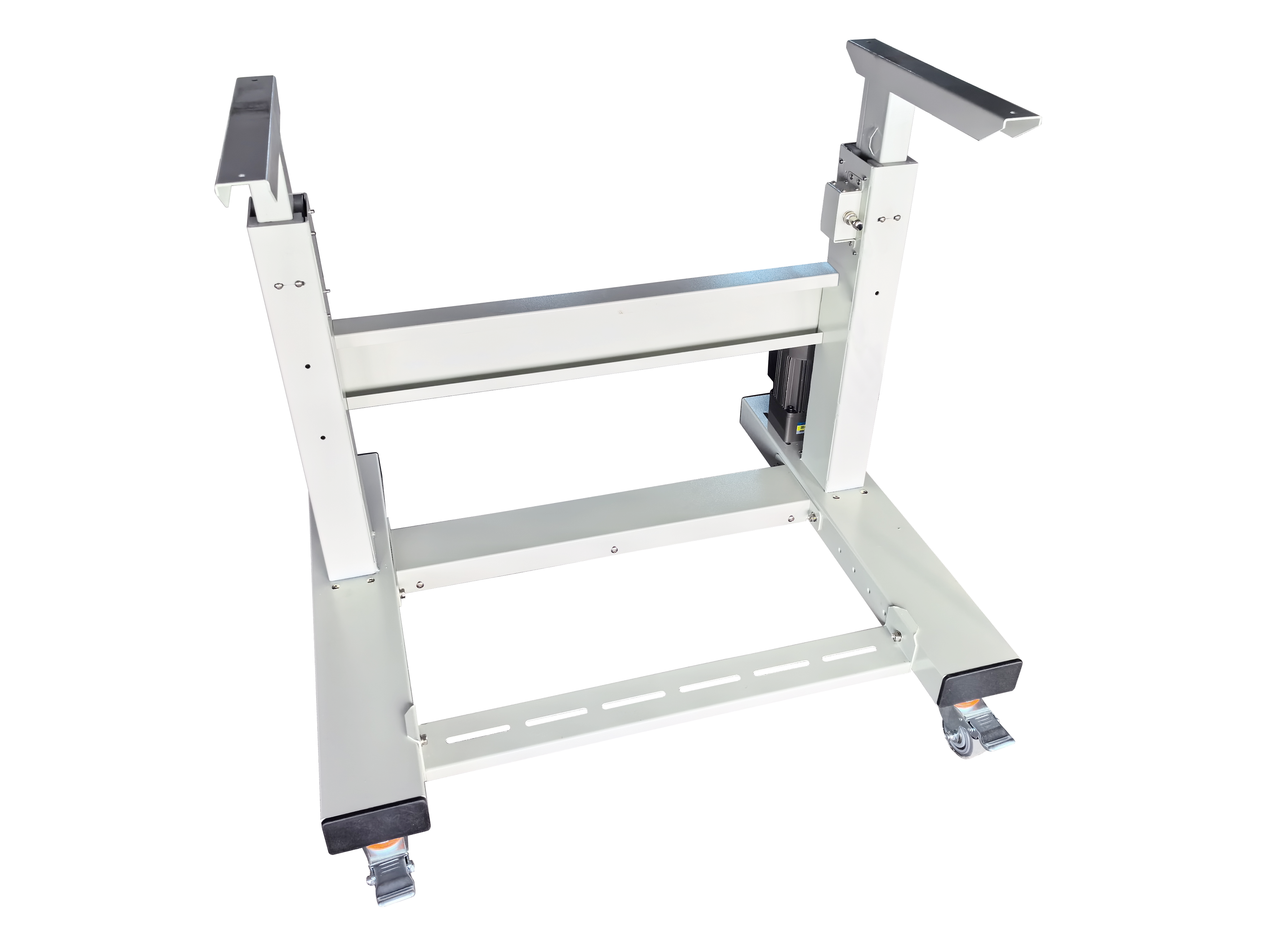
Occupational health studies consistently advocate for regular postural variation to prevent musculoskeletal disorders, as human bodies are not designed to remain static for eight hours a day. Alternating between sitting for intricate needlework and standing for broader tasks actively stimulates blood circulation. Specifically, when maneuvering heavy canvas or cutting long fabric panels, standing engages the core muscles, shifts the weight-bearing load off the lumbar spine, and sustains operator focus over extended production shifts.
In commercial alteration shops or shared maker spaces, a single fixed-height table cannot accommodate the varying statures of different operators. A motorized base resolves this logistical challenge entirely. Advanced models feature digital memory presets, allowing different users to save their ideal sitting and standing heights. This functionality standardizes comfort and safety across the entire workforce without wasting time manually recalibrating the workspace.
Industrial manufacturing environments demand uncompromising durability. Commercial facilities typically deploy heavy-duty models constructed with reinforced, high-gauge steel and intelligent memory controllers. These units possess the structural integrity required to support massive industrial sergers, walking foot machines, and multi-needle embroidery units. They can handle dynamic loads often exceeding 300 lbs without experiencing any lateral wobble during peak operational speeds of thousands of stitches per minute.
Recent market analyses highlight a fascinating evolution within the textile equipment sector. Driven by stricter occupational health mandates, there is a surging commercial demand for adaptive workstations. Interestingly, this trend has spilled over into the consumer market. We are witnessing a prosumer movement where serious home quilters and independent fashion designers are bypassing lightweight domestic desks. Instead, these creators are investing in an Industrial Smart Sewing Elevator Stand to achieve factory-level rigidity in their home studios, protecting expensive machinery from the wear and tear of unstable, bouncing surfaces.
For casual domestic users, spatial efficiency and budget often dictate purchasing decisions. Hobbyist solutions generally feature lighter aluminum frames and integrated storage compartments for bobbins. While these lighter models are adequate for standard domestic mending, they frequently lack the motor torque and structural cross-bracing necessary to lift heavier, professional-grade textile equipment safely.
Feature | Hobbyist Stand | Industrial Elevator Stand |
|---|---|---|
Construction | Lightweight Aluminum | Reinforced Heavy-Gauge Steel |
Weight Capacity | Under 100 lbs | 150 lbs - 300+ lbs |
Vibration Control | Minimal | Advanced Industrial Dampening |
Adjustment | Manual or Basic Electric | Precision Dual-Motor Electric |
Standard standing desks are fundamentally inadequate for serious sewing applications. A dedicated motorized base must not only support the static weight of the machine but also dynamically absorb the kinetic energy of high-speed vibrations. Insufficient lateral stability results in table bounce, which compromises stitch quality and creates an unsafe environment for the operator guiding the needle.
The reliability of the internal lift mechanism dictates the functional lifespan of the table. Single-motor systems are cost-effective but may struggle with uneven loads over time, potentially causing the desk to tilt. Dual-motor electric stands, which house a motor in each leg, provide superior torque and synchronized leveling. High-quality brushless DC motors operate with minimal noise, maintaining a peaceful work environment during adjustments.
Furthermore, the configuration of the work surface is a critical ergonomic variable. Flat-top tables require the machine to sit above the surface, forcing the operator to elevate their arms and strain their wrists. Premium setups utilize flush-mount inserts or drop-down platforms. These designs allow the sewing machine bed to sit perfectly level with the surrounding table, facilitating smooth, frictionless fabric feeding—an absolute necessity for professional quilting.
Managing the bulk of a king-sized quilt on a standard table is physically exhausting. The weight of the batting and backing often drags off the edge, pulling against the needle. Elevating the workstation allows the quilter to utilize their entire upper body for leverage. This mechanical advantage makes it infinitely easier to baste and maneuver heavy, multi-layered fabrics across the surface without fighting gravity.
Precision is the cornerstone of professional tailoring. Bridal shops and bespoke suit makers use adjustable stands to elevate complex garments closer to eye level. This proximity is essential for executing intricate hand-stitching or inspecting seam allowances. Additionally, during client fittings, the raised table serves as an ideal high-level presentation and pinning surface.
Beyond sewing, a professional workstation often serves versatile purposes. By raising the motorized base to its maximum height, the unit transforms into a back-friendly cutting table. This elevation allows pattern makers to stand directly over the fabric, apply safe downward pressure on rotary cutters, and reach across wide bolts of material without overextending their lumbar spine.
While technically possible for light mending, it is highly discouraged for regular use. Standard standing desks lack the lateral stability to absorb the oscillating vibrations of a sewing machine. A dedicated base is engineered with specialized cross-bracing to prevent wobbling at high speeds, protecting both your machine and your stitch quality.
High-quality industrial models are built for exceptional load-bearing capacity, typically supporting between 150 lbs and 300 lbs. This robust capacity makes them capable of supporting heavy commercial machines and dense fabric rolls without straining the lift motors.
This depends on the tabletop, but many premium height-adjustable setups feature drop-down platforms or custom inserts. These allow the bed of the machine to sit flush with the workspace, ensuring frictionless feeding of fabric.
Modern electric stands utilize quiet brushless DC motors. The noise level is generally rated under 50 decibels, equivalent to a quiet conversation. They adjust smoothly without disrupting your focus.
Standing requires a slight workflow adjustment. You can place the pedal on a raised, non-slip stool or use a knee-lift lever. Many modern machines also allow for an electronic start and stop button to enable entirely pedal-free operation.
Upgrading to a height-adjustable system represents a strategic commitment to operational excellence. Whether you are outfitting a large commercial facility or a serious home studio, a specialized motorized base delivers stability and essential support. For those ready to optimize their workflow, explore our professional-grade solutions to ensure your workspace matches your ambitions.


