

Views: 0 Author: Site Editor Publish Time: 2026-08-28 Origin: Site


Cutting room floors face a high-stakes reality every single day. Handling stretch knits demands extreme precision to avoid severe dimensional distortion. You routinely manage challenging materials like spandex, elastane blends, and tubular knits. You simply cannot afford to mismanage these highly volatile fabrics.
Standard manual pulling methods cause drastic latent stretch during the spreading process. Once operators cut the fabric, it inevitably relaxes. The material rapidly shrinks back to its original state. This unpredictable shrinkage leads directly to rejected garments. It also creates astronomical material waste that damages your bottom line.
Today, adopting a modern automated Fabric Spreading Machine is a strict requirement for knitwear production. It is no longer just an optional luxury. We will explore how specific tension-free mechanisms and sensor-driven edge alignment actively mitigate material distortion. Read on to learn how servo technologies protect your critical production margins.
Stretch knit fabrics require "positive feeding" to eliminate tension, rather than being pulled off the roll.
A servo fabric spreading machine dynamically adjusts feed rates in real-time to match spreading speed, ensuring zero-tension lays.
Automated edge alignment reduces ply-to-ply waste by up to 2-3cm per edge.
Evaluating a machine requires looking beyond speed to focus on ply accuracy, sensor reliability, and operator training requirements.
You must understand the physics of latent stretch to grasp the true problem. When you pull knit fabrics under tension, they artificially elongate. Think of it like pulling a rubber band across a table. The fabric appears flat and smooth in the moment. However, it holds massive internal kinetic energy waiting to release.
The post-cut reality reveals a complete operational nightmare. The fabric naturally relaxes after your team cuts the pattern pieces. The once-perfect dimensions suddenly shrink. This results in mismatched seams during the sewing phase. It causes incorrect garment sizing. Ultimately, it severely compromises the final fit for the consumer.
The financial cost of this mishandling compounds rapidly. Manual spreading delays slow down your entire production line. High-stretch knits often require mandatory 24-hour "relaxing" periods on valuable table space. You also suffer from incredibly high scrap rates when patterns fail to align. These inefficiencies destroy profit margins.
To eliminate these bottlenecks, you must define clear success criteria for your cutting room:
Consistent ply tension: Every layer must lay completely flat without internal stress.
Perfectly aligned edges: Side edges must stack precisely to minimize lateral waste.
Reduced manual handling: The system must eliminate physical pulling by human operators.
Eliminated resting time: The process should allow for immediate cutting after spreading.
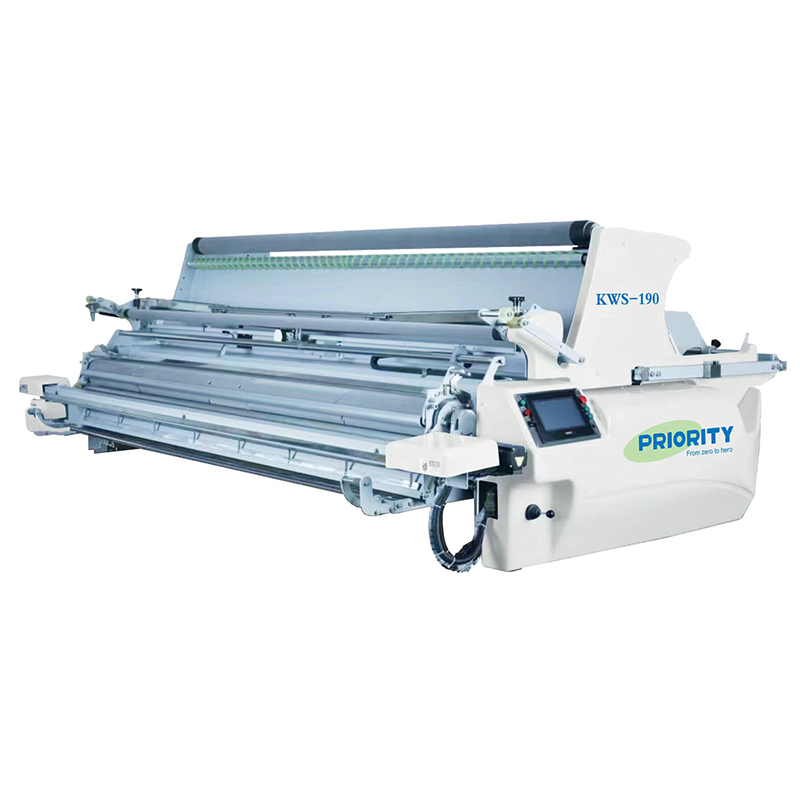
You cannot use traditional bar feed systems for stretch knits. A bar feed pushes a metal rod through the center core of the roll. It then pulls the fabric forcefully to unroll it. This pulling action introduces severe tension. Instead, a cradle feed system is strictly mandatory for knits. A cradle uses a belt-driven trough to support the entire weight of the roll. It unrolls the fabric through gentle surface contact.
Positive feeding mechanisms actively deliver fabric to the cutting table. The machine unrolls the material at the exact rate the carriage travels. A "dancer roller" plays a critical role here. This weighted or sensor-driven tension bar rests lightly on the fabric. It detects micro-tensions instantly. It then signals the feed motor to speed up or slow down to maintain perfect equilibrium.
Edge alignment sensors, often called EPC (Edge Position Control), secure the lateral accuracy of the lay. Photo-electric sensors continuously monitor the edge of the falling fabric. They instruct the cradle to shift smoothly from side to side. This ensures perfect edge alignment on the table. It completely solves the common issue of telescoped or uneven knit rolls.
Advanced machines also utilize specific environmental controls to assist delicate knits.
Air flotation tables: These blow a cushion of air beneath the bottom ply to reduce table friction.
Anti-static bars: These neutralize static electricity to prevent lightweight synthetic knits from clinging together.
Spiral rollers: These decrimp and uncurl the stiff edges of single jersey knits before laying.
Standard induction motors simply cannot handle high-stretch elastane blends effectively. Standard motors suffer from mechanical lag. They start abruptly and stop heavily. This jerking motion stretches the fabric during directional changes. In contrast, servo motors provide instantaneous responses. They offer highly precise speed and torque adjustments at the microsecond level.
Synchronization represents the biggest advantage of servo technology. A Servo Fabric Spreading Machine perfectly synchronizes its carriage travel speed with the fabric unrolling speed. If the machine accelerates, the unrolling motor accelerates at the exact same exponential curve. This guarantees the fabric never pulls tight or pools on the table.
Knits do not behave uniformly throughout a single roll. The outer layers might be tightly wound. The inner layers near the core might be loose. Servo-driven systems adapt instantly to these variable elasticities. They sense heavier or lighter sections of the fabric roll instantly. They adjust the feed rate without requiring any operator intervention.
You might remain skeptical about the initial capital expenditure (CapEx) of servo systems. They certainly cost more upfront than standard automated spreaders. However, the reduction in daily fabric waste is massive. You also gain superior garment quality and consistency. These factors yield a highly predictable and rapid return on investment for high-volume knit producers.
You must evaluate potential machines based on strict material compatibility constraints. Verify the maximum roll weight capacity against your specific knit suppliers' standards. Some high-density activewear rolls weigh over 100 kilograms. You also need to confirm the maximum fabric width capacity. Your machine must comfortably accommodate the widest rolls you process.
Next, guide your evaluation based on fabric construction. You must determine if you process tubular knits or standard open-width knits. Tubular knits require specific mechanical attachments to spread correctly. Standard flat machines will cause center-crease distortion on tubular rolls if they lack the correct feeding frames.
Software compatibility directly impacts your operational speed. Assess how the machine's internal PLC or touchscreen integrates with your broader cutting room software. It should seamlessly communicate with your existing CAD/CAM systems. This ensures operators can easily download marker lengths and complex ply counts without manual data entry.
Finally, frame your evaluation around long-term durability and maintenance. Look beyond the shiny exterior. Check the availability of replacement edge sensors. Investigate the typical belt lifespan within the cradle feed. Most importantly, verify the availability of local technical support. Downtime on a spreading machine stops the entire cutting room.
Machine Evaluation Criteria Chart
Feature / Specification | Evaluation Criteria | Business Outcome |
|---|---|---|
Maximum Roll Weight | Compare to supplier's heaviest shipment. | Prevents motor burnout and cradle stalling. |
Tubular vs. Open-Width | Check for specialized tubular frames. | Eliminates edge creasing on seamless knits. |
CAD/CAM Integration | Verify network compatibility (LAN/Wi-Fi). | Reduces manual data entry errors by 90%. |
Local Support Network | Response time for technician visits. | Minimizes costly production line downtime. |
You must maintain realistic expectations regarding the "zero-tension" myth. No machine achieves absolute zero tension in a strict physics sense. Rather, they achieve a controlled, consistent, and exceptionally minimal tension. Standard knits can usually be cut immediately. However, some highly volatile, high-elastane fabrics may still require a brief resting period. This rest time drops drastically from 24 hours to perhaps just one hour.
Address the reality of the operator skill gap immediately. Transitioning from manual spreaders to machine operators involves a steep learning curve. The primary challenge shifts entirely from physical labor to technical monitoring. Operators no longer pull heavy fabrics. Instead, they must calibrate sensitive photo-sensors. They must navigate digital menus to set accurate ply parameters.
Advanced spreading machines are highly sensitive to your cutting room environment. Environmental factors directly impact performance. Knits naturally produce high amounts of airborne dust and lint. This lint easily blocks optical alignment sensors. You must enforce strict daily cleaning protocols. Compressed air blow-downs at the end of every shift are mandatory to keep sensors functioning perfectly.
Managing stretch knits effectively is fundamentally a physics problem. You solve this problem through positive feed mechanics and precise servo-synchronization. By eliminating manual pulling, you protect the dimensional integrity of your elastane blends. This technology moves your cutting room from chaotic guesswork to predictable precision.
To justify this investment, calculate your current monthly fabric waste first. Next, quantify the financial loss of table-resting bottlenecks. These two metrics usually build a foolproof business case for automation. A modern spreading machine quickly pays for itself in saved material alone.
Actionable Next Steps:
Audit your current cutting room to identify exactly how much lateral edge waste you produce per lay.
Calculate the total hours lost each week waiting for high-stretch knits to relax on your tables.
Demand a live test or vendor demonstration using your own most difficult, high-stretch fabric rolls before committing to a purchase.
Establish a training timeline to help manual operators transition into technical machine supervisors.
A: It significantly reduces it, often dropping resting times from 24 hours down to just a few hours or even zero. This depends entirely on the spandex percentage. However, highly volatile fabrics may still require brief acclimatization to settle completely before cutting.
A: Specialized machines manage this using specific attachments. They can be equipped with edge-decrimping devices, such as spiral rollers or targeted air-blowers. These devices engage right before the fabric lays flat to actively uncurl the stiff edges.
A: For rigid wovens, a standard automated spreader may suffice. For high-stretch knits and activewear, the servo drive's micro-adjustments are strictly necessary to prevent dimensional distortion. This makes the return on investment easily justifiable through saved fabric alone.


