

Views: 0 Author: Site Editor Publish Time: 2026-08-28 Origin: Site


Garment manufacturing profit margins rely heavily on strict material efficiency. In fact, raw fabric represents 60% to 70% of total garment production costs today. Every single inch you save directly boosts your bottom line. Unfortunately, manual spreading operations serve as a primary source of hidden material leakage rather than just a production bottleneck. Human error routinely causes excessive end-loss, inconsistent tension, and unnecessary splicing overlaps on the cutting table. These minor daily losses quietly compound into massive annual financial deficits. You must transition to an automated strategy to preserve those shrinking margins. We will explore how upgrading your cutting room shifts the focus from mere speed to measurable raw material yield. You will learn exactly how these systems recover lost fabric, evaluate equipment upgrades, and measure the real financial impact.
Automated spreading eliminates manual inconsistencies, directly recovering 2% to 5% of fabric previously lost to end-allowance and splicing waste.
Tension-free spreading mechanisms prevent fabric distortion, reducing post-cut shrinkage and rejected garments.
A Servo Fabric Spreading Machine provides the necessary micro-adjustments for handling highly elastic or technical textiles without margin-destroying distortion.
ROI evaluations should prioritize material savings per ply over maximum spreading speed, as fabric costs quickly eclipse equipment depreciation.
You cannot fix waste until you identify exactly where it happens. Manual cutting rooms hide inefficiencies very well. Supervisors often praise fast operators. However, speed in manual spreading usually creates severe material leakage. The true cost of manual labor hides in the fabric scraps swept away at the end of every shift.
Human operators systematically leave excessive fabric at the ends of markers. They do this to avoid short plies. If an operator cuts a ply too short, the final garment pieces will miss essential fabric. To prevent this, workers overcompensate. They often leave three to five centimeters of extra fabric at both ends. This seems minor. Yet, in a 100-ply lay, a five-centimeter overage on both ends wastes 10 meters of fabric. Over a month, this manual end-loss destroys thousands of dollars in potential profit.
Fabric rolls eventually run out mid-marker. Operators must introduce a new roll. They manually overlap the fabrics during these roll changes. Unfortunately, manual workers rarely align splice-marks perfectly. They rely on visual estimation. They usually overlap far more fabric than necessary just to feel safe. This excessive overlap generates pure waste. Every sloppy splice converts expensive raw material into unusable floor scraps.
Manual handling naturally introduces the "stretch and snap-back" effect. Operators pull heavy fabric down the table. This pulling action stretches the fibers. They cut the fabric while it remains under tension. The real problem occurs after cutting. The tension releases. The fabric naturally snaps back to its relaxed state. Garments cut under tension will shrink right off the table. This leads to unsewable parts. You end up with complete product write-offs.
Manual spreading creates uneven edges along the sides of the lay. Operators cannot keep a perfectly straight edge over a 10-meter table. Because the edges wander, CAD teams must leave wider side buffers in their digital markers. They shrink the usable marker width to guarantee safety. This artificial buffer forces marker planners to waste valuable lateral space.
Common Mistakes in Manual Rooms:
Ignoring end-loss measurements during daily quality checks.
Allowing operators to set their own splice-overlap distances.
Stretching knit fabrics manually to meet length requirements.
Failing to track the weight of discarded scraps per shift.
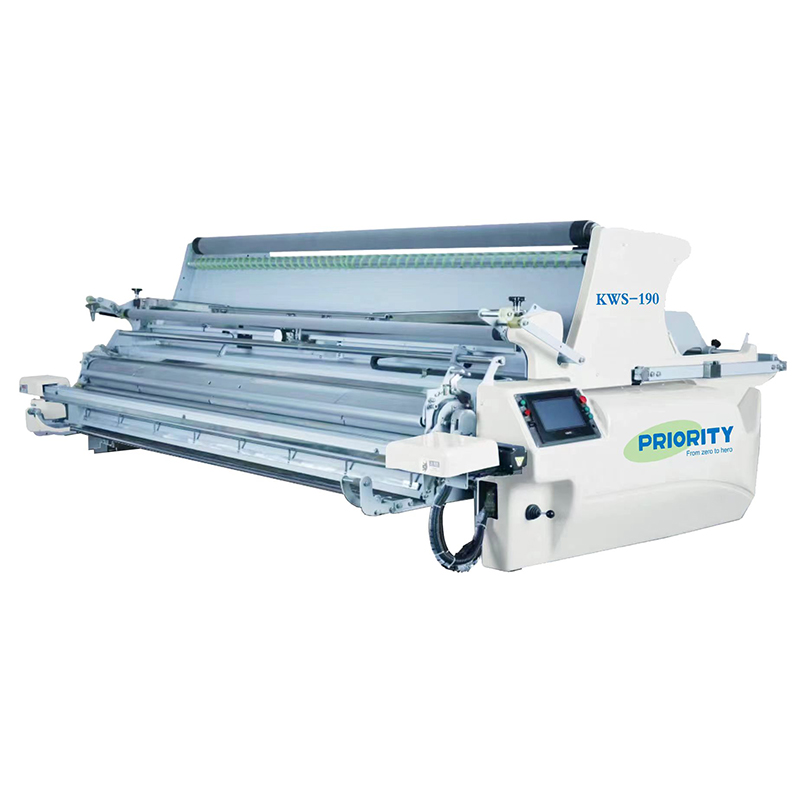
An automated Fabric Spreading Machine attacks waste through precise mechanical control. It removes human guesswork from the equation. Let us examine the specific features driving yield recovery.
Sensors continuously realign the roll during the unwinding phase. These photocells read the fabric edge hundreds of times per minute. They communicate instantly with the machine cradle. The cradle shifts laterally to keep the fabric dropping exactly on the designated line.
This creates a perfectly plumb edge down the entire lay. Marker planners no longer need thick safety buffers. They can utilize the fabric edge-to-edge. This simple alignment feature instantly increases marker efficiency.
A positive feed system mechanically unwinds the fabric at the exact speed of the machine's forward motion. A traditional cradle might drag the fabric. A positive feed system pushes it gently. The pre-feed roller creates a small slack loop just before the fabric touches the table.
This creates a strictly "tension-free" lay. The fibers remain completely relaxed. Cut pieces match the CAD dimensions perfectly. You eliminate rejection waste caused by off-table shrinkage.
Modern equipment features programmable lay lengths paired with motorized rotary cutters. You input the exact marker length into the control panel. The machine travels precisely to that millimeter. The motorized blade glides across the width, delivering a perfectly square cut.
This reduces end-allowance dramatically. You shift from a variable manual estimate of three to five centimeters down to a precise, repeatable standard. Automated machines consistently achieve under one centimeter of waste per end. The savings compound incredibly fast.
Smart machines integrate directly with fabric inspection data. They know exactly where textile flaws exist before the roll even starts. The system stops automatically at known fabric flaws.
This allows operators to splice exactly at the defect. In the past, workers discarded entire yards of usable fabric just to ensure the flaw missed the marker. Defect management software minimizes the cut-out area. It saves surrounding good fabric.
Not all automated machines handle difficult textiles equally. Woven fabrics behave very differently than lightweight knits. You must match your motor technology to your primary material types.
Standard machines utilize AC inverter motors. These are highly adequate for stable wovens. Denim, canvas, and heavy cotton sit nicely on the table. They do not stretch easily. Standard motors provide reliable service for these rigid materials. However, they carry massive risks for knits. AC motors often start and stop abruptly. This micro-jerking pulls sensitive fibers.
A Servo Fabric Spreading Machine operates on a completely different level. It utilizes closed-loop feedback. The motor constantly reads its own speed and position. It adjusts acceleration and deceleration instantly. The servo gently ramps up speed. It never yanks the fabric roll. It glides into stops.
Servo motors prevent the sudden jerking motion entirely. This protects highly elastic materials. Elastane, spandex, and lightweight activewear knits require this gentle handling. If you introduce sudden tension into elastane, it stores that kinetic energy. It will snap back aggressively after cutting. Servo technology guarantees these sensitive fibers lay perfectly dormant.
You must audit your current fabric mix. We recommend servo-driven models specifically for facilities cutting difficult materials. If knits, activewear, or technical textiles make up more than 30% of your production volume, standard AC motors will damage your margins. The premium paid for a servo drive pays for itself through eliminated garment rejections.
Feature | Standard AC Motor Machine | Servo Driven Machine |
|---|---|---|
Acceleration Profile | Fixed, sometimes abrupt | Smooth, continuously variable |
Tension Control Accuracy | Moderate | Extremely High |
Ideal Fabric Types | Denim, Canvas, Poplin | Spandex, Lycra, Fine Knits |
Initial Investment | Lower | Higher |
Executives need hard numbers. You cannot justify capital expenditures on vague promises of quality. You must prove financial viability through strict material mathematics.
You can forecast your daily savings using a simple calculation framework. The formula is: (Average end-loss saved per ply) × (Number of plies per day) × (Cost per yard/meter).
Imagine saving 4 centimeters per ply on a table running 2,000 plies daily. You save 80 meters of fabric every single day. If that fabric costs $5 per meter, you recover $400 daily. That equals $10,000 per month purely from end-loss recovery. This equation proves automation value immediately.
Many managers assume automation simply cuts headcount. While manual laborers may drop, the true value lies in skill upgrades. You upgrade operators from manual pullers to quality controllers. One worker manages the machine while inspecting the lay for rogue defects. You reallocate your labor budget toward quality assurance. This prevents bad cuts from ever reaching the sewing floor.
Standalone machines work well. Connected machines dominate the industry. Modern spreading technology integrates directly with automated CAM cutters and factory ERP systems. The digital marker sends length data straight to the spreader. The spreader reports exact yardage consumed back to the ERP. Managers can track actual fabric utilization against estimated consumption in real-time. This stops fabric theft and identifies bad supplier rolls instantly.
You should demand transparent financial benchmarks. Facilities cutting over 2,000 garments daily typically see equipment payback within 12 to 18 months. This timeline relies purely on fabric savings. It explicitly excludes labor improvements or increased throughput. Once the machine pays for itself, those recovered material costs become permanent profit margin increases.
Daily Garment Volume | Est. Monthly Fabric Saved (Meters) | Estimated Payback Timeline |
|---|---|---|
1,000 - 1,500 | 800 - 1,200 | 18 - 24 Months |
2,000 - 3,000 | 1,500 - 2,500 | 12 - 18 Months |
5,000+ | 4,000+ | 8 - 12 Months |
Technology only succeeds when supported by proper infrastructure and training. Buying the machine solves half the problem. Integrating it smoothly dictates your final success.
Automated equipment demands precision environments. These machines require perfectly leveled, reinforced cutting tables. They weigh hundreds of kilograms. Retrofitting existing manual tables often fails miserably. Old tables sag under the weight. The machine track will bend. If the track bends, the edge alignment fails. You must install dedicated power rails overhead to prevent cable dragging. Budget for table upgrades from day one.
Human resistance destroys technological advantages. The learning curve matters. Technology fails when operators override tension settings to speed up the process. Old habits die hard. A manual worker wants to pull the fabric. You must enforce strict training protocols. Operators must trust the machine's feed rate. Make sure supervisors audit machine settings randomly to ensure compliance.
You must match machine specifications to your facility's supply chain realities. Every machine carries a maximum roll weight and a maximum roll diameter. If your suppliers send 150-kilogram jumbo rolls, a 100-kilogram capacity spreader will fail instantly. Audit your inbound fabric warehouse before purchasing equipment. Verify max weights, core tube sizes, and open-width limits.
Precision tools require continuous care. Neglected sensors immediately negate waste-reduction benefits. If dust covers the photocell, edge alignment wanders. Dull end-cutters chew the fabric rather than slicing it cleanly. This creates jagged edges and pulls tension into the lay. Regular calibration is absolutely mandatory.
Essential Maintenance Best Practices:
Wipe down all infrared photocell sensors with a microfiber cloth at the start of every shift.
Check the rotary blade sharpness weekly and replace immediately upon dulling.
Blow out fabric lint from the track rails daily to prevent wheel jamming.
Schedule a monthly laser-level check on the cutting table surface.
The garment industry is shifting its perspective entirely. You must view an automated fabric spreading machine as a precision measurement and material conservation tool, not just an automation engine. Speed means nothing if you waste expensive raw materials. Proper tension control and sharp edge alignment protect your profit margins directly.
Your choice between a standard model and a highly responsive servo unit depends heavily on your facility's fabric mix. High-stretch knits demand servo control. Stable wovens tolerate standard inverters. Make the right choice based on engineering, not just upfront pricing.
Your next step requires immediate action. Advise your production decision-makers to audit current manual end-loss and tension-rejection rates. Establish a firm numerical baseline today. Once you possess your true waste numbers, request manufacturer demos. Always insist on running test-lays using your absolute most difficult fabrics to verify performance.
A: Most facilities experience a realistic fabric recovery rate between 2% and 5%. The exact number depends heavily on your prior manual inefficiency. Eliminating excessive end-loss and shrinking side buffers account for the vast majority of these savings. Over thousands of yards, this tiny percentage yields massive financial returns.
A: No. Standard inverter-driven machines are usually more than sufficient for stable wovens like cotton, denim, and canvas. A servo model represents an unnecessary over-investment in this specific scenario. You only require servo technology if you plan to transition heavily into knits, spandex, or lightweight performance wear.
A: Standard open-width machines will not work for tubular fabrics without significant modification. You require specific tubular attachments or specialized tubular spreading machines. These specialized units feature inner frames that gently open the tube without stretching the side creases during the lay process.
A: Edge alignment relies strictly on sensor visibility and track stability. You must perform daily sensor cleaning to remove fabric dust. Additionally, you should execute a monthly alignment calibration. Always ensure the track rails remain free of lint buildup, which can cause the machine wheels to vibrate and disrupt the sensor reading.


