

Views: 0 Author: Site Editor Publish Time: 2026-07-17 Origin: Site


The cutting room frequently operates as the primary bottleneck in modern apparel manufacturing facilities. Moving from manual processes to automated spreading represents a high-stakes operational decision rather than a simple equipment purchase. You must weigh efficiency against capital investment carefully before upgrading your line.
Today, rising labor costs and relentless material waste force factory managers to completely re-evaluate their spreading operations. Inconsistent fabric tension poses severe challenges, especially when handling delicate stretch materials. These tension irregularities routinely cause post-cut shrinkage. This shrinkage leads to sizing defects and destroys your profit margins.
This guide provides an objective, evidence-based evaluation of automated versus manual spreading systems. We explore how different technologies align with your daily production volume, specific fabric mix, and expected return on investment. You will learn exactly how to choose the optimal setup for your factory floor.
Volume Thresholds: Manual spreading is cost-effective for micro-runs and bespoke tailoring, but becomes a margin-killer at volumes exceeding 1,000 garments per day.
Fabric Integrity: The primary advantage of an automatic knit woven spreader machine is tension-free laying, which drastically reduces post-cut shrinkage and sizing defects in stretch fabrics.
Hidden Upgrades: Moving to automation often requires infrastructure changes, such as upgrading your existing fabric spreading table to support increased machine weight and air-flotation requirements.
ROI Timeline: When calculating ROI, factories must factor in fabric savings (typically 2-5%) alongside labor reduction, balancing this against maintenance and training costs.
We must first understand the operational reality of traditional cutting rooms. Manual spreading relies entirely on human expertise. Operators use their hands to align fabric edges. They constantly pull and adjust materials to manage tension. This human element introduces significant variability into your daily production.
You can achieve acceptable results using a Manual Fabric Spreader under specific conditions. Micro-factories often thrive using these traditional setups. We recommend manual systems for several distinct scenarios.
Low-volume production handling under 500 layers per day.
High-mix, low-volume (HMLV) orders requiring constant fabric roll changeovers.
Tubular fabrics processing where basic manual frames suffice.
However, relying solely on human operators introduces severe hidden risks. Consistent tension control becomes impossible as the day progresses. Operator fatigue naturally leads to stretched knits. These stretched layers eventually relax after cutting. Your perfectly patterned pieces will shrink into unsewable shapes.
You also face higher fabric waste due to inaccurate edge alignment. Operators struggle to keep ply ends perfectly straight. They often overcompensate by cutting longer sections. This slight overage compounds over thousands of layers. Furthermore, manual cutting departments suffer from high turnover rates. Labor dependency makes your production schedule vulnerable to sudden staff shortages.
Common Mistake: Many managers ignore the cost of operator fatigue. They calculate labor hours linearly. In reality, material waste spikes sharply during the final two hours of a manual shift.
Modern automation fundamentally changes the cutting room dynamic. An automatic knit woven spreader machine removes the human variable from tension and alignment equations. Motors and sensors replace hands and eyes. This shift guarantees absolute consistency across every single fabric lay.
Stretch fabrics demand extreme care during the spreading process. Spandex and elastane blends require mechanical relaxation to prevent post-cut dimension changes. Automated machines achieve tension-free feeding through advanced internal mechanisms.
The equipment uses dancer rollers to feed the fabric smoothly. Electronic slack sensors continuously monitor the material loop. They automatically adjust the feed roller speed to match the machine's travel speed. The fabric essentially drops onto the table under its own weight. This process eliminates any unnatural stretching.
Manual visual checks waste enormous amounts of time and material. Automated systems utilize infrared edge-sensing technology instead. These sensors track the fabric edge in real time. They instantly shift the machine cradle sideways to maintain perfect alignment.
You can calculate massive compounding material savings through this technology. Saving just one or two centimeters per lay end seems insignificant initially. However, multiply this saving by 500 layers. Then multiply it by 300 working days. The sheer volume of rescued fabric often pays for the equipment itself.
Many factories process highly diverse material catalogs. You need equipment capable of addressing dual knit and woven capabilities. Automated machines adjust feed rates seamlessly. They modify cradle configurations through simple touchscreen commands.
Operators can switch from rigid woven denim to delicate knit jersey in minutes. The machine handles the heavy pulling required for thick twill. It then instantly switches to the ultra-sensitive slack feeding required for lightweight knits. You do not need separate machines for different product lines.
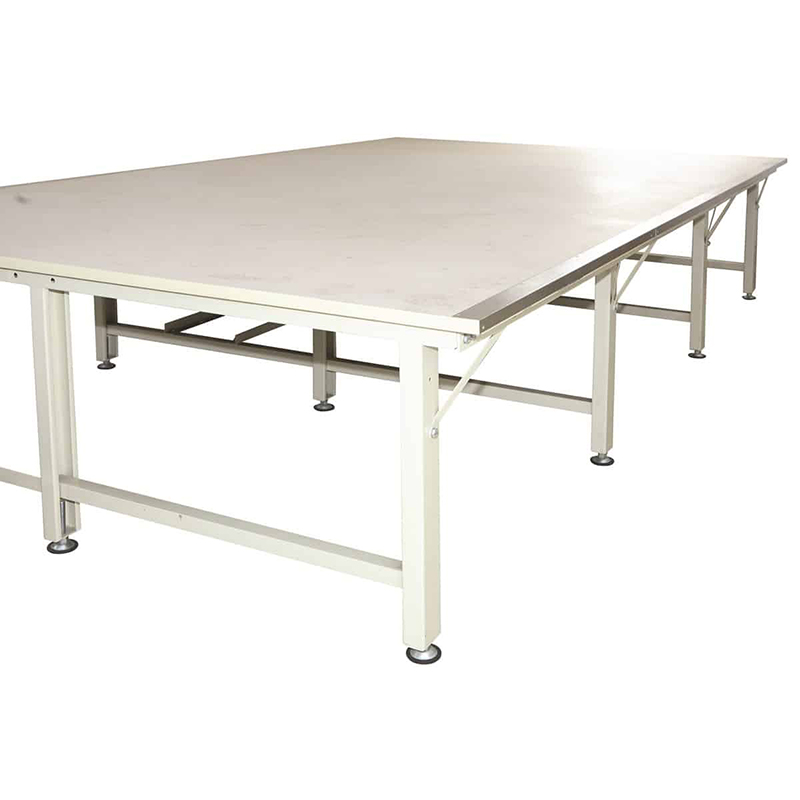
The assumption trap ruins many factory upgrade budgets. Managers frequently assume they can simply place new automated machines on their current setups. This mistake causes severe installation delays and budget overruns.
A standard automated spreader carries massive weight. The equipment alone can weigh between 250kg and 400kg. Add a 100kg fabric roll, and the total load becomes immense. Upgrading your Fabric Spreading Table is usually mandatory. Your tables must feature reinforced steel frames. They require precision-machined guide rails to keep the heavy machine on track.
You must also consider air flotation systems. Heavy automated machines create dense, tightly packed fabric lays. Moving these heavy stacks manually to an automatic cutter is physically impossible without damaging the bottom layers. Air-flotation tables solve this problem.
These specialized tables feature hundreds of tiny surface holes. Internal blowers push air upward to create a cushion. The heavy fabric stack glides effortlessly across the surface. However, this upgrade requires careful electrical planning. You must install adequate power supplies and industrial air compressors to handle the load.
Space configuration also dictates your infrastructure planning. You need a dedicated loading zone equipped with motorized roll lifters. The heavy machine requires a clear travel zone. You must map these areas carefully to avoid disrupting normal factory floor traffic.
Upgrading to automated spreading requires a transparent financial evaluation. You must compare the initial capital expenditure (CAPEX) of automated machines against the ongoing operating expenses (OPEX) of manual labor. This analysis determines your true payback period.
Labor efficiency provides the most immediate financial impact. A standard manual table typically requires a two-to-three person team. One automated machine requires only a single operator. You can reassign the remaining workers to other critical production areas. This reduction slashes your daily labor expenses significantly.
Fabric utilization metrics offer even larger financial returns. We model return on investment based directly on fabric cost. Saving three percent on high-cost woven silks generates massive daily savings. Technical knits yield similar financial returns. These expensive materials pay off the machine significantly faster than basic cotton.
You must also factor maintenance and potential downtime into your models. Automated machines require OEM parts for optimal performance. You must implement strict preventive maintenance schedules. The risk of automated downtime necessitates having trained technicians available. You should budget for these ongoing support costs.
Financial Metric | Manual Operation Profile | Automated Operation Profile |
|---|---|---|
Initial CAPEX | Minimal setup costs | High upfront equipment costs |
Labor Requirements | 2-3 operators per table | 1 operator per machine |
Material Utilization | High end-loss and edge waste | Optimized edges, minimal loss |
Maintenance Needs | Basic physical repairs | Sensor calibration, OEM parts |
Output Scalability | Limited by human endurance | Consistent high-speed output |
Best Practice: Always calculate material savings using your most expensive fabric. This baseline provides the most accurate view of your maximum potential savings. It highlights the true value of precision edge alignment.
Choosing the correct spreading solution requires a structured assessment. You cannot rely on vendor brochures alone. We developed a specific framework to guide your purchasing decision.
You must evaluate three primary metrics carefully. This assessment matrix reveals exactly where your operational bottlenecks exist.
Production Volume: Calculate your daily processed yardage or meters. Volumes exceeding 1,000 garments daily strongly favor automation.
Fabric Complexity: Analyze your percentage of stretch knit versus stable woven materials. High knit percentages demand electronic tension control.
Labor Availability: Review local wages and cutter turnover rates. High turnover areas benefit massively from reduced operator dependency.
You might discover full automation exceeds your current budget or space constraints. In these cases, you should consider the semi-automatic compromise. Intermediate solutions bridge the gap effectively. Motorized manual catchers and basic edge-alignment frames offer decent upgrades. They improve manual processes without the massive footprint of a fully automated rig.
Your vendor evaluation process must be ruthless. Never accept a demonstration using the vendor's optimized demo roll. These rolls are perfectly wound and highly stable. Instead, demand a live test run using your most difficult knit fabric. Bring your slipperiest technical fabrics to the demo room. The machine must prove its tension control capabilities on your actual production materials.
Assessment Variable | Low Complexity Score | High Complexity Score | Recommendation |
|---|---|---|---|
Daily Garment Volume | Under 500 units | Over 1,000 units | Automate at high volume |
Fabric Stretch Factor | Rigid wovens only | High elastane knits | Automate for stretch |
Operator Turnover | Stable workforce | Constant retraining needed | Automate for stability |
Manual spreaders remain highly viable for niche operations and low-volume setups. However, an automatic knit woven spreader machine is a mandatory operational upgrade for scaling factories. It solves the critical issues of tight profit margins and strict quality controls. Moving to automation guarantees consistent tension, precise edges, and minimal fabric waste.
Your immediate next step requires data collection. Conduct a strict 30-day material waste audit on your current manual tables. You need to establish a firm baseline regarding your end-loss and tension defects. Do this before requesting any automated equipment quotes.
We highly encourage you to book a technical consultation with an equipment specialist. Request a customized ROI calculation based entirely on your specific factory data. Bring your toughest fabric rolls to the conversation and demand a proven solution.
A: Yes, but it requires specific modular attachments. You will need tubular spreading frames for closed loops and standard cradles for open-width rolls. Reconfiguring the machine takes time during changeovers. Factories with frequent shifts between these types should schedule production blocks carefully.
A: Most operators master basic machine functions within three to five days. However, troubleshooting complex tension settings takes longer. Handling highly elastic or extremely slippery fabrics requires experiential learning. Managers should expect full operational fluency within three to four weeks of daily use.
A: Not always, but it remains highly likely. Automated spreaders are extremely heavy. If your current table lacks heavy-duty guide rails, adequate load-bearing capacity, or air-flotation systems, you must upgrade. Retrofitting an old, weak table is usually more expensive than installing a new compatible unit.
A: No. Tension-free spreading significantly reduces material stretch during the lay. However, high-elastane fabrics still retain internal yarn stress from the manufacturing roll. They may still require resting time on the table. This duration is often much shorter, depending strictly on your factory's specific quality tolerances.


