

Views: 0 Author: Site Editor Publish Time: 2026-08-05 Origin: Site


Quality escapes in apparel manufacturing directly erode profit margins and severely damage buyer trust. Optimizing your quality assurance workflow requires deploying the right equipment at the precise production stage. You cannot afford to catch upstream material errors at the final packing station. Global supply chain pressures make stringent quality control more critical than ever before. While often confused in procurement searches, a fabric inspection machine and a garment checking table are not interchangeable substitutes. They solve completely different defect categories at opposite ends of your production timeline. Choosing the wrong asset leaves your factory floor vulnerable to critical quality failures. This guide breaks down the functional differences, implementation realities, and evaluation frameworks. We will help production managers allocate capital efficiently based on actual defect origin data. You will discover exactly how to optimize both inbound and outbound quality checks to protect your brand.
Production Stage: Fabric inspection machines handle raw material intake (preventing flaws before cutting), while garment checking tables focus on end-line inspection of assembled pieces.
Automation vs. Manual: Machines provide motorized, roll-to-roll continuous checks; a quality control table relies entirely on manual manipulation and static visual checks.
Investment Logic: Choosing between them isn't an "either/or" decision—it is a matter of prioritizing capital based on whether your highest defect costs stem from raw fabric flaws or construction/sewing errors.
Understanding the fundamental mechanics of these two assets is the first step toward better quality management. They operate differently, require distinct operator skill sets, and target entirely separate defect categories. We must define their core functions clearly to avoid costly procurement mistakes.
Function: This is a motorized industrial system. It unrolls, illuminates, measures, and rewinds raw fabric rolls continuously. Operators monitor the moving textile web to spot inherent material flaws before they reach the cutting room floor.
Key Features:
Under-lighting (Backlit Panels): High-intensity translucent panels illuminate the fabric from below. They make microscopic misweaves, pinholes, and thin spots instantly visible.
Digital Length Counters: Precision sensors measure the exact yardage or meterage as the fabric unrolls. This verifies supplier invoicing and ensures you have enough material for your production run.
Tension Control Systems: Motorized dancer rollers maintain consistent fabric tension. They prevent delicate or elastic materials from stretching unnaturally during the rewinding process.
Automated Edge Alignment: Optical sensors track the fabric edge. They guide the rewinder to create a perfectly straight, neat roll ready for the automated spreader machine.
Defect Target: Inspectors use these machines to find weaving errors, yarn slubs, dye variations, holes, and edge faults. Industry professionals usually grade these flaws using the standard 4-Point System. Under this framework, operators assign penalty points based on the length and severity of each defect. They then calculate a total score per 100 square yards to accept or reject the entire roll.
Function: This is a flat, ergonomically designed workstation. It facilitates the manual, static inspection of cut panels or fully assembled garments. You use an industrial QC table primarily at the end of your sewing lines. Inspectors manipulate the garment by hand to check construction integrity.
Key Features:
Overhead D65 Lighting: These stations feature simulated daylight bulbs. D65 lighting provides a color temperature of 6500 Kelvin. This precise lighting prevents metamerism, ensuring colors match perfectly across different garment panels.
Embedded Measuring Tapes: Factory-installed rulers sit flush along the table edges. They allow inspectors to verify sizing specs rapidly without fumbling for loose measuring tapes.
Smooth Anti-Snag Surfaces: The table top uses specialized laminate or polished metal. It prevents delicate fabrics like silk or chiffon from catching and tearing during rapid manipulation.
Angled Presentation Tops: Many modern tables feature adjustable tilting mechanisms. They reduce severe neck and back strain for inspectors working long, demanding shifts.
Defect Target: Human inspectors focus on construction errors here. They look for seam puckering, skipped stitches, incorrect sizing, loose threads, and hardware failures like broken zippers or missing buttons. These are errors introduced entirely during the manufacturing process, not material flaws from the textile mill.
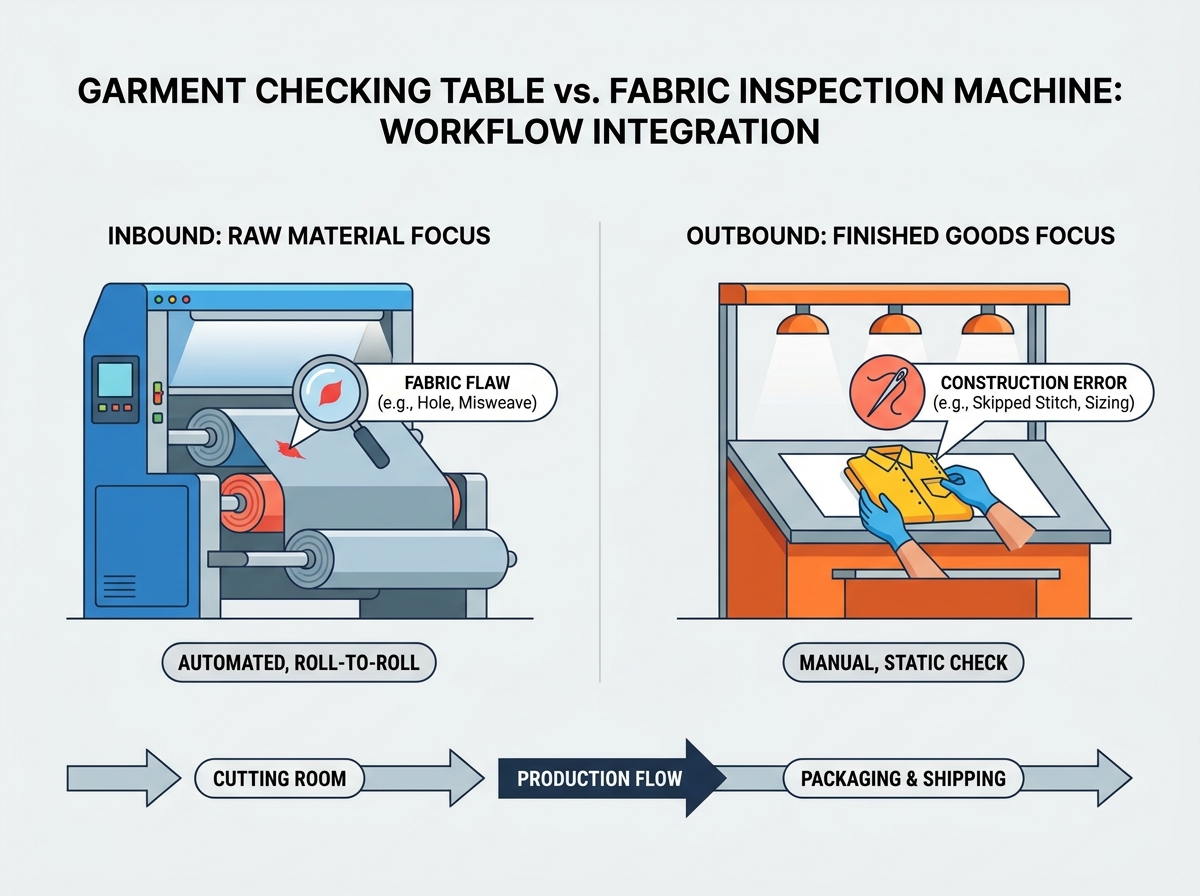
You must map these two pieces of equipment to your factory floor layout accurately. Placing a machine at the wrong stage of your production pipeline creates severe bottlenecks. Let us examine exactly where these assets belong within a standardized apparel manufacturing process.
Equipment: Fabric Inspection Machine.
Process Goal: You must identify and quarantine defective yardage before the fabric ever reaches the cutting room. Operators run 10% to 100% of incoming rolls through the machine, depending on supplier reliability. They tag flaws physically or digitally. Spreading machine operators later read these tags to cut around the defects.
Financial Impact: This inbound defense prevents the compounding cost of manufacturing flawed goods. Imagine cutting, sewing, trimming, and pressing a complex jacket, only to discover a massive fabric run in the center panel. You just wasted hours of paid labor on an inherently flawed, unsellable item. Catching the flaw upstream limits your loss to a few inches of raw material.
Equipment: quality inspection table.
Process Goal: This station serves as your final compliance checkpoint. Inspectors execute AQL (Acceptable Quality Limit) random sampling here. For luxury or highly technical garments, factories often perform 100% visual inspection. Inspectors check every single finished piece before bagging and boxing. They measure dimensions, test zippers, and verify label placements.
Financial Impact: This setup acts as your ultimate firewall. It prevents defective garments from reaching retail buyers or direct consumers. Slipping here causes catastrophic brand damage. Retailers impose severe financial chargebacks for non-compliant shipments. A robust end-line checking protocol protects your brand reputation and secures your operational margins.
How should a production manager evaluate their current equipment needs? Procurement decisions require objective frameworks, not guesswork. You must analyze your factory data, measure your space, and project your throughput requirements. Below are the key dimensions to guide your investment strategy.
Evaluation Dimension | Fabric Inspection Machine | Manual Checking Station |
|---|---|---|
Primary Goal | Raw material intake verification | Finished garment compliance |
Defect Focus | Slubs, holes, dye shading, width variances | Stitching, sizing, hardware, seam integrity |
Throughput Speed | High (15–30 meters per minute) | Low to Medium (1–5 garments per minute) |
Space Requirement | Large footprint, requires forklift clearance | Compact, modular, easily relocated |
Operator Skill | Technical machine operation, 4-Point System knowledge | Visual acuity, spec sheet reading, tactile assessment |
You should never buy equipment blindly. Implement an actionable framework starting with your data. Audit your last quarter's defect and return reports. You need to isolate the root cause of your highest failure rates.
Scenario A: Do fabric faults cause over 40% of your returns? Are buyers complaining about dye lot shading, pinholes, or unexpected fabric shrinkage? If yes, you must prioritize a motorized fabric inspection machine to clean up your inbound supply.
Scenario B: Are your defects mostly construction-based? Do you see rampant issues with crooked topstitching, mismatched panels, or sizing variations? If yes, you need to upgrade your quality control table stations immediately. Better lighting and ergonomic setups will help your inspectors catch these assembly errors.
Machines inspect massive volumes of material rapidly. A standard unit processes 15 to 30 meters of fabric per minute. However, scaling this requires dedicated floor space and heavy power infrastructure. If you buy a second machine, you might need to rewire that section of your facility.
Conversely, a checking station handles individual, discrete garments. Throughput depends entirely on human speed. Scaling this process requires buying more modular tables and hiring more inspectors. While the initial capital expense is lower, your ongoing operational expenses (OPEX) will increase due to labor costs.
Fabric machines demand significant square footage. You need the machine's footprint plus extensive clearance for loading and unloading heavy textile rolls. Your facility often requires specialized forklifts or overhead hoists to move 100-kilogram rolls safely into the machine cradle.
Manual checking tables offer flexibility. They are modular and relatively lightweight. Factory managers can rearrange them easily as floor layouts change between seasons. You can cluster them for complex outerwear inspections or line them up sequentially for high-volume t-shirt checks.
Every equipment integration carries hidden challenges. Trustworthy facility planning requires acknowledging these non-obvious risks. Understanding what goes wrong helps you implement robust preventative measures from day one.
The motorized nature of these machines introduces physical risks to your raw materials. You must mitigate these actively.
Tension Distortion: Poorly calibrated machines stretch knitted or elastane-blended fabrics during the roll-to-roll process. If inspectors wind the fabric too tightly, the material "relaxes" and shrinks after cutting. This leads to highly inaccurate, undersized garment panels.
Maintenance Overhead: These units require specialized technical servicing. You must clean motors, calibrate tension sensors, and align edge-tracking photocells regularly. If sensors fail or accumulate factory dust, the machine passes crooked or flawed fabric without triggering alarms.
Best Practice: Schedule weekly calibration checks for all tension sensors. Require operators to verify machine edge-alignment accuracy at the start of every single shift.
Manual stations face biological and environmental risks. Humans run these processes, so human limitations apply.
Inspector Fatigue: Reliance on 100% human visual checking leads to natural accuracy drop-offs. Staring at stitches under bright lights causes severe eye strain. As a shift progresses, inspectors inevitably miss critical flaws.
Standardization Failures: Factory floors often suffer from inconsistent ambient lighting. If your tables lack standardized overhead lux levels, color shading checks will fail. Shadows mask seam puckering. This negates the table's entire value proposition.
Common Mistake: Relying on standard warehouse fluorescent tubes above a checking station. You must install dedicated D65 daylight simulators directly over the inspection surface, blocking out conflicting ambient factory light.
Many procurement teams ask if they can consolidate these functions. We must address this misconception directly. Giving direct, evidence-based advice requires dispelling industry myths and establishing clear implementation phases.
Do not attempt to use a static table to inspect 500-yard rolls of fabric. It is physically impossible to maintain tension, measure yardage, or spot edge flaws manually across long webs. Likewise, do not buy an automated roll machine expecting it to check finished jacket seams. They perform entirely distinct tasks. You cannot swap them to save money.
Capital is often tight for growing factories. You should adopt a phased integration approach to protect your cash flow while improving quality.
Phase 1 (Outbound Focus): Invest in high-grade manual checking stations first. This ensures your outbound product remains strictly compliant with buyer demands. During this phase, outsource your fabric inspection to your textile mill. Mandate that they provide certified 4-Point System inspection reports before shipping rolls to your facility.
Phase 2 (Inbound Focus): Bring fabric inspection machines in-house eventually. Execute this step as your production volume grows significantly. You should also trigger this phase if raw material inconsistencies begin threatening your margins. Owning both ends of the process creates a holistic, unbreachable Quality Management System.
Stop guessing about your equipment needs. Calculate your current cost-of-poor-quality today. Aggregate your returns, chargebacks, and internal rework labor costs. Match the primary source of your defects to the corresponding equipment class. If material flaws drain your profits, quote a roll machine. If sewing errors drive returns, buy better tables. This data-driven matching justifies the return on investment for your purchase clearly to your stakeholders.
Effective apparel manufacturing requires defending both ends of your production pipeline. The fabric inspection machine serves as your inbound defense mechanism. It quarantines defective raw materials before they waste your labor hours. Meanwhile, the garment checking table acts as your outbound compliance tool. It guarantees finished goods meet exacting buyer specifications before shipping. Evidence-based procurement relies entirely on understanding your specific factory bottlenecks. You should never choose one piece of equipment over the other in a vacuum.
Next Steps for Production Teams:
Audit your defect logs from the past ninety days to categorize material vs. construction errors.
Evaluate your available floor space and electrical infrastructure.
Standardize the lighting above all current manual inspection areas to D65 specifications.
Request 4-Point System reports from your textile suppliers immediately.
A: No. While automated machines reduce the physical labor of rolling fabric, trained operators are still required to identify, grade, and tag the defects as the fabric moves, unless utilizing highly expensive AI-vision systems. Even with AI, human oversight remains necessary to interpret nuanced dye shading.
A: A professional quality control table should utilize overhead D65 (daylight) or standardized CWF/TL84 lighting to ensure accurate color matching and defect visibility without casting shadows. The light source must evenly illuminate the entire table surface without causing harsh glare.
A: Generally, no. These machines measure length (yardage/meters), width, and visual defects. GSM checks require cutting a physical swatch and using a specialized GSM scale and cutter on a static table. You must perform this test offline to preserve the roll's integrity.


