


Views: 0 Author: Site Editor Publish Time: 2026-08-03 Origin: Site


Finding garment defects relies entirely on visual contrast. This makes the physical inspection environment a critical bottleneck in textile manufacturing. You simply cannot fix what your operators cannot see.
A specialized inspection station acts as a precision optical tool rather than a simple workbench. Standard factory illumination often masks subtle color differences and textural flaws. Subpar lighting directly causes operators to miss crucial defects before shipping. This failure pipeline leads to costly false passes, retailer chargebacks, and surging rework expenses.
In this guide, we deconstruct the exact technical lighting requirements necessary to standardize quality assurance. You will learn how specific illumination metrics protect your production profit margins. We will explore how proper color temperatures reveal hidden inconsistencies. Finally, we will show you how to maintain operator accuracy during long shifts through better ergonomic design.
Contrast is Key: Proper illumination on a quality inspection table highlights fabric faults, seam puckering, and shading differences that standard factory lighting obscures.
Standardized Metrics Matter: Effective inspection requires specific Color Rendering Index (CRI), color temperature (D65), and Lux baseline parameters to ensure objective evaluation.
Ergonomics Drive Accuracy: Uncalibrated lighting causes visual fatigue, leading to a drop in defect detection rates during the later hours of an operator's shift.
Strategic Investment: Evaluating a quality control table requires assessing not just the frame, but the integration, adjustability, and maintenance of its light sources.
Garment factories often treat lighting as an afterthought. Many facility managers assume overhead fluorescent tubes provide enough visibility for daily tasks. However, quality assurance demands clinical precision. Failing to optimize your inspection environment triggers a chain reaction of financial losses.
Poor lighting actively hides critical manufacturing errors. A dim environment blends subtle oil stains into dark fabrics seamlessly. Minor color mismatches between a sleeve and a bodice disappear entirely under low-contrast illumination. When operators cannot see these issues, defective garments pass through final inspection.
This false-pass scenario damages your bottom line immediately. Retail buyers possess rigorous inbound quality checks. They will spot the defects you missed. Buyers then issue severe chargebacks, demand heavy discounts, or reject entire shipments outright. Beyond immediate financial penalties, shipping defective goods erodes long-term brand trust. Rebuilding a damaged reputation takes years.
Subpar lighting also creates imaginary problems. Inconsistent overhead factory lighting casts strange shadows across workpieces. Flickering bulbs alter the perceived texture of flat fabrics. These optical illusions create phantom defects.
An operator might spot a dark shadow and flag the garment for inconsistent dyeing. The item goes back to the rework station. Mechanics and floor supervisors waste valuable time examining a perfectly good product. This false-fail loop bottlenecks your production line. It forces your team to waste labor hours chasing non-existent errors. Consistent, shadow-free illumination eliminates this unnecessary rework.
Relying on ambient factory lighting destroys standardized quality control. Factory environments change drastically throughout the day. Morning sunlight streaming through windows creates a vastly different visual environment than evening darkness. Weather conditions shift the ambient light from warm to cool in minutes.
You cannot standardize quality when your environment fluctuates constantly. A night shift operator evaluating a navy blue shirt sees a completely different garment than a morning shift operator. Standardizing your process requires a dedicated QC table. This isolates the inspection zone from unpredictable ambient factors. It ensures every garment undergoes evaluation under the exact same optical conditions, regardless of facility location or time of day.
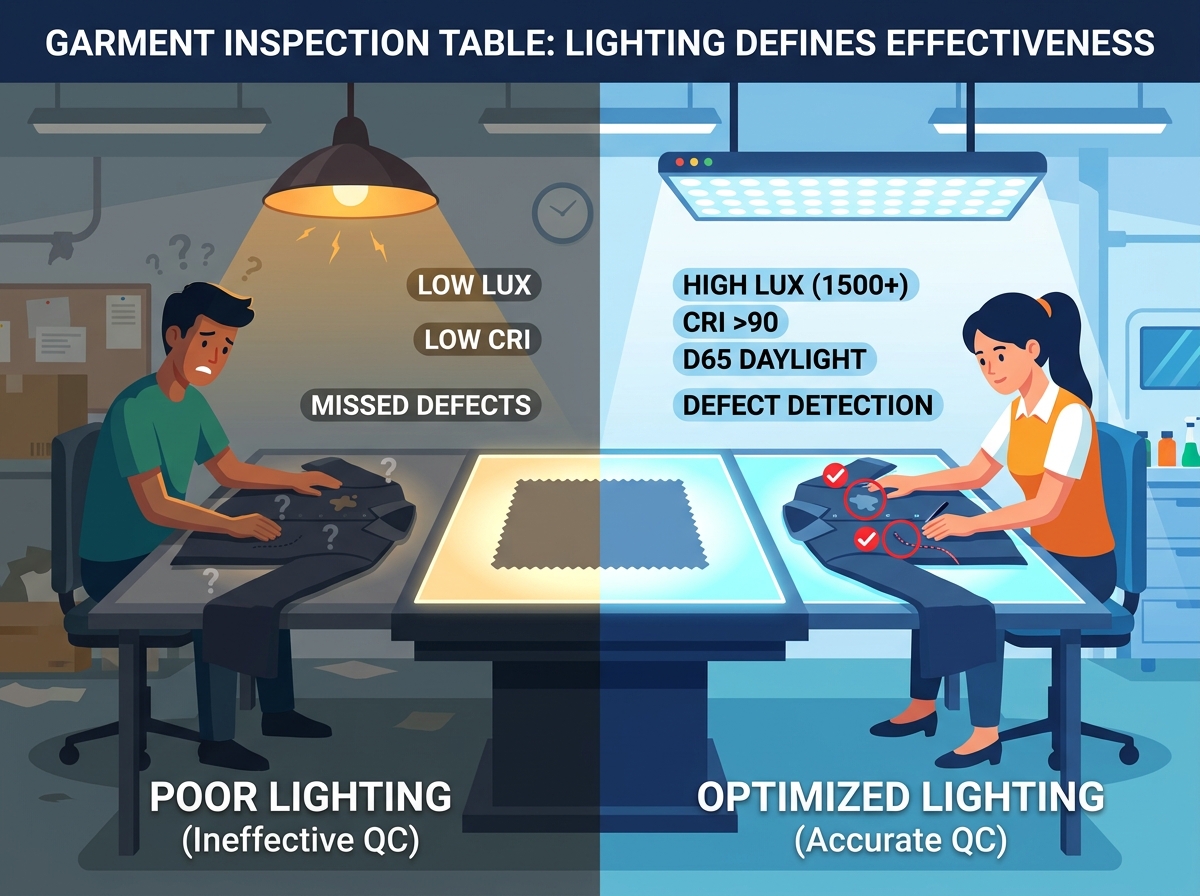
Transforming a basic workstation into a reliable inspection tool requires precise technical upgrades. You must align your lighting hardware with established industrial standards. We have broken down the four non-negotiable optical metrics.
Illuminance measures the total amount of light hitting a specific surface. Textile evaluation requires exceptionally high lux levels for close-proximity work. General office spaces typically operate around 300 to 500 lux. Garment inspection demands a baseline of 1,000 to 1,500 lux.
Many occupational safety frameworks mandate these higher thresholds for fine-detail manufacturing. Darker fabrics absorb massive amounts of light. Inspecting black denim or dark wool requires even higher intensity to reveal structural flaws. High illuminance forces surface irregularities to stand out against the fabric grain.
The Color Rendering Index scores how accurately a light source reveals true colors compared to natural sunlight. The scale runs from 0 to 100. Standard warehouse bulbs usually score between 60 and 70. This low score washes out subtle hues and makes shade-matching impossible.
For garment inspection, a CRI greater than 90 remains strictly non-negotiable. Panel shading ranks among the most common reasons for buyer rejection. If a left sleeve dye lot differs slightly from the main body, a high-CRI light source highlights the discrepancy immediately. Investing in 90+ CRI ensures total color consistency across all garment panels.
Color temperature dictates the warmth or coolness of the light. Textile professionals rely on the D65 standard, which equals roughly 6500 Kelvin. This specific temperature replicates natural midday daylight in the Northern Hemisphere.
Why does this matter? Fabrics look different under warm residential bulbs (2700K) versus cool industrial bulbs (5000K). Retailers evaluate garments under standardized D65 conditions. If you inspect under a different color temperature, you risk a phenomenon called metamerism. Colors might match perfectly under your factory lights but clash horribly in the buyer's evaluation room. D65 bulbs eliminate this mismatch.
Total lux output means nothing if the distribution remains uneven. A single bright spotlight creates blinding glare in the center and deep shadows on the edges. Even, shadow-free dispersion across the entire surface eliminates blind spots.
Operators must scan garments quickly. If the light fades near the corners of the table, inspectors will miss defects located on sleeve cuffs or hemlines. High-quality fixtures utilize diffusers to spread photons equally across the entire work zone.
Lighting Metric | Standard Recommendation | Primary Benefit |
|---|---|---|
Illuminance (Lux) | 1,000 - 1,500+ Lux | Highlights textural flaws and minor stains on dark fabrics. |
CRI (Color Rendering) | >90 Score | Reveals subtle shade variations between garment panels. |
Color Temperature | 6500K (D65) | Matches retailer testing environments to prevent metamerism. |
Distribution | 100% Edge-to-Edge Evenness | Eliminates edge shadows and optical blind spots. |
Different textile flaws require different optical strategies. A singular light source cannot reveal every possible defect. The most effective quality inspection table utilizes a dual-lighting approach to capture surface-level and internal anomalies.
Top-down illumination handles the vast majority of visual inspections. When you angle overhead lights correctly, they wash over the fabric surface to highlight structural deviations. This method effectively exposes the following defects:
Weaving Faults: Broken yarns, dropped stitches, and slubs become immediately visible under intense surface light.
Localized Staining: Machine oil, dirt marks, and stray dye drops contrast sharply against the clean fabric base.
Hardware Irregularities: Scratched buttons, misaligned zippers, and damaged snaps reflect surface light differently than intact hardware.
Surface lighting acts as your first line of defense against obvious visual contamination.
Surface light fails to reveal internal structural issues. This requires transmitted light, pushing photons from underneath the fabric up through the weave. A well-designed workstation incorporates a translucent acrylic light box directly into the desk surface.
When an operator lays a garment flat over an illuminated acrylic base, the light exposes hidden nightmares. Pinholes glow brightly. Uneven fabric density looks like dark clouds. Missing internal stitches become instantly apparent. You cannot accurately inspect lightweight knits, activewear meshes, or waterproof membranes without powerful under-lighting.
Certain materials possess a directional nap. Velvet, corduroy, and fleece reflect light differently depending on the viewing angle. Flat, static overhead light often hides nap irregularities.
Adjustable light positioning solves this problem. Angling the top light source at 45 degrees casts micro-shadows across the fabric grain. These micro-shadows reveal seam puckering perfectly. They also highlight areas where the fabric nap was crushed during pressing. Giving operators the ability to tilt and pivot the light source empowers them to find complex textural defects.
Even the most advanced optical equipment fails if the human operator becomes compromised. Quality assurance requires intense, sustained visual concentration. Poor ergonomic design actively sabotages your workers' physical capabilities over time.
Human eyes function like muscles. They tire under prolonged strain. Factory managers often notice a phenomenon called defect detection decay. During the first two hours of a shift, operators catch 95% of all flaws. By hour seven, that detection rate plummets significantly.
Straining under inadequate light accelerates this fatigue curve. When an environment lacks sufficient lux, the pupil dilates continuously to capture more detail. This micro-muscular strain causes severe eye fatigue. Upgrading your illumination straightens out the fatigue curve, keeping detection rates high throughout the entire workday.
Too much light creates just as many problems as too little light. Harsh hotspots bouncing off the workspace blind operators temporarily. This forces them to look away and break concentration.
Proper inspection setups combat this through material choices. Light fixtures must utilize frosted diffusers to soften the beam. Furthermore, the workstation surface itself requires a matte, anti-reflective finish. Glossy metal or polished wood surfaces reflect light directly into the user's eyes. Matte acrylic or textured laminates absorb the bounce, protecting the operator's vision.
Older fluorescent tubes pulse at low frequencies. While often invisible to the naked eye, the human brain registers this constant flickering. Over an eight-hour shift, this invisible strobe effect triggers debilitating headaches and migraines.
Modern setups demand high-frequency ballasts or premium LED drivers. Flicker-free LED technology delivers a constant, unbroken stream of light. This eliminates the neurological stress associated with older lighting systems, allowing operators to maintain deep focus.
One brightness setting does not fit all materials. Inspecting a highly reflective synthetic windbreaker under maximum lux creates intolerable glare. Conversely, inspecting thick winter wool requires every available lumen.
Providing dimmable controls allows operators to customize their environment based on the specific production run. They can dial down the intensity for glossy polyesters and crank it up for matte cottons. This simple adjustability drastically improves user comfort and sustained accuracy.
Ergonomic Feature | Physical Impact on Operator | Quality Control Result |
|---|---|---|
Anti-Glare Diffusers | Reduces direct eye strain and squinting. | Operators inspect longer without taking visual breaks. |
Flicker-Free Drivers | Prevents neurological fatigue and headaches. | Maintains high detection rates during late-shift hours. |
Dimmable Controls | Prevents blindness from reflective synthetics. | Allows accurate inspection of high-gloss fabrics. |
Procuring new factory equipment requires careful assessment. A properly configured quality control table integrates robust structural design with highly specific optical components. You must evaluate these units holistically before committing to a purchase.
The physical structure matters just as much as the bulbs. Inspecting heavy garments requires a stable, vibration-free platform. Flimsy aluminum frames wobble during rapid sorting, which distracts operators and disrupts focus. Prioritize heavy-duty steel construction.
Additionally, look for anti-static properties. Synthetic garments generate massive static charges as they slide across standard plastics. An anti-static workstation prevents electrical shocks and keeps dust from clinging to the fabric. Finally, tilt-angle capabilities allow operators to adjust the desk slant. This prevents severe neck and back pain during continuous seated or standing work.
Lights burn out. LEDs degrade. When this happens, you need a system designed for rapid maintenance. Carefully assess how easily maintenance teams can replace overhead panels and under-table bulbs.
Avoid manufacturers using proprietary, hard-to-replace fixtures. If a custom LED board fails, you might wait weeks for an overseas replacement. During that downtime, your inspection station becomes entirely useless. Select units utilizing standardized bulb sizes or widely available commercial LED drivers. Modular designs allow your internal technicians to swap parts in minutes, minimizing costly production bottlenecks.
Factory environments contain numerous electrical hazards. Combining high-voltage industrial lighting with fabric dust creates a significant fire risk. Never purchase uncertified equipment.
Ensure the entire electrical assembly carries recognizable industrial safety certifications. Look for CE, UL, or CSA markings on the power supplies, wiring harnesses, and ballasts. Properly grounded equipment protects your facility from catastrophic electrical fires and keeps your workforce safe from accidental shocks.
Upgrading your inspection stations represents a crucial risk-mitigation strategy, not merely a routine equipment purchase. Standardizing your optical environment directly protects your brand from devastating retailer chargebacks and wasted rework hours.
We recommend taking immediate action on the factory floor:
Purchase a digital lux meter and measure the actual light intensity at your current inspection stations.
Audit your existing bulbs to confirm they meet the strictly required >90 CRI and D65 color temperature standards.
Replace any workstations utilizing glossy surfaces or flickering fluorescent tubes to protect operator ergonomics.
Do not let poor visibility drain your profit margins. Review dedicated catalogs for industrial inspection solutions today, or request a professional consultation to optimize your factory lighting infrastructure.
A: The standard baseline ranges from 1,000 to 1,500 lux for fine textile evaluation. Standard factory lighting usually maxes out around 500 lux, which remains vastly insufficient. If your facility frequently inspects dark-colored fabrics like black denim or navy wool, you should push your intensity closer to 2,000 lux to guarantee defect visibility.
A: LEDs offer superior benefits, including vastly longer lifespans, lower heat emission, and flicker-free operation. However, you must purchase industrial LEDs specifically rated for high CRI (>90) and D65 color temperature. Cheap consumer LEDs distort fabric colors terribly. High-end LEDs easily match traditional fluorescent accuracy while providing better ergonomics.
A: You should establish a preventative replacement schedule between 2,000 and 5,000 operating hours. Light sources degrade long before they physically burn out. Even if a bulb continues emitting light, its color temperature shifts and its CRI score drops over time. Replacing them proactively ensures consistent color evaluation.
A: No. Ambient factory illumination suffers from severe distance drop-off and casts deep shadows created by machinery and workers. Task-specific lighting concentrates intense, shadow-free illumination directly onto the work surface. General overhead upgrades cannot replicate the precise angles, diffusers, and under-lighting required for rigorous quality control.


