

Views: 0 Author: Site Editor Publish Time: 2026-08-09 Origin: Site


Quality assurance operators endure long hours of rigorous visual and physical inspection daily. Physical discomfort in these demanding environments directly triggers noticeable cognitive decline. This compromises critical focus when precision matters the most. Operator fatigue goes far beyond a basic human resources or safety concern. It poses a direct, measurable risk to quality assurance outputs. This fatigue causes missed defects and incrementally slower production cycle times. Fixed workstations force inspectors into awkward, static postures. This creates immense physical strain throughout long shifts.
An adjustable structural intervention solves this inherent problem effectively. It perfectly aligns the workstation to accommodate varied human biomechanics and distinct inspection tasks. In this article, you will discover the hidden business costs of fatigue in QA roles. We will explore how modernizing your setup safeguards both employee health and product integrity. You will learn actionable criteria for selecting the best equipment to boost accuracy and throughput on your floor.
Fixed-height workstations force operators into compromised postures, directly accelerating physical and visual fatigue.
An adjustable quality control table mitigates repetitive strain by allowing seamless transitions between sitting and standing, accommodating multiple shift workers.
Evaluating a quality inspection table requires assessing load capacity, stability at maximum extension, and integration with task lighting or testing peripherals.
Implementing ergonomic tables requires minor facility planning (power routing, footprint) but offers measurable ROI through reduced defect slip-through and lowered absenteeism.
Constant neck or back pain heavily distracts operators from their primary tasks. It fractures their focus and depletes mental energy reserves. When inspectors manage localized pain, their visual acuity drops significantly. They increasingly miss critical defects or flag false positives. Cognitive load increases exponentially as physical endurance decreases. Focus should remain entirely on the product being inspected. It should never be spent managing a nagging backache. Prolonged discomfort directly correlates with a higher rate of inspection errors. This creates a dangerous liability for quality control departments.
Muscle fatigue builds rapidly when workers maintain static postures. Operators instinctively compensate by taking more frequent micro-breaks. They stretch, shift their weight, or temporarily step away from the line. These tiny interruptions compound dramatically over an eight-hour shift. Ultimately, they incrementally slow down the entire inspection cycle time. This hidden bottleneck severely delays downstream manufacturing processes. You lose valuable minutes every hour due to physical exhaustion. Over a month, these lost minutes translate into significant production delays. Managing this fatigue keeps your throughput metrics consistently high.
Repetitive Strain Injuries (RSIs) present serious long-term operational risks. Musculoskeletal disorders (MSDs) often plague specialized quality control roles. Recovering from these severe injuries leads to extensive employee absenteeism. Medical claims and workers' compensation premiums rise quickly. Finding and training replacement talent disrupts overall production stability. Specialized QA roles require months of rigorous training to master. High turnover directly hurts your bottom line and morale. Investing in preventative workplace design retains your highly skilled personnel much longer. It demonstrates a tangible commitment to employee well-being and safety.
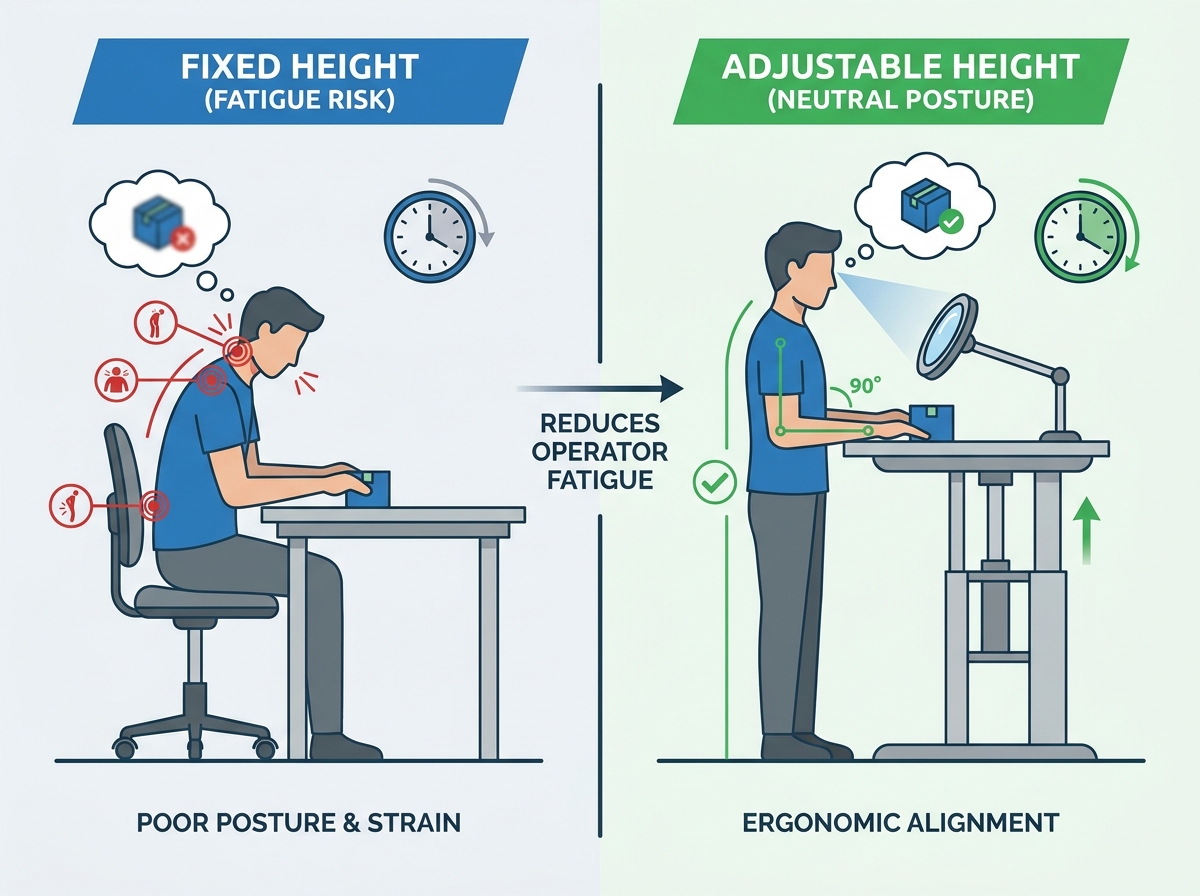
Ergonomics experts strongly advocate for maintaining a neutral posture. Adjusting the table height allows workers to keep elbows at a 90-degree angle. They can easily maintain straight, completely unstressed wrists. A premium QC table makes this precise alignment seamless and intuitive. By minimizing daily joint stress, inspectors conserve significant physical energy. They naturally avoid unnatural reaching, bending, or excessive stretching. This practice drastically cuts the onset of daily fatigue. Operators finish their shifts feeling energized rather than physically depleted. Implementing neutral posture principles creates a more sustainable daily workflow.
Modern industrial facilities often run multiple consecutive shifts. Operators of vastly different heights share the same workstation daily. Standard fixed desks fail to accommodate this structural diversity. They force painful compromises on the 5th and 95th percentile workers. Adjustability ensures both petite and tall workers find ideal ergonomic setups. It transforms a rigid space into a universally accommodating environment. You no longer have to build custom stations for specific employees. One highly adaptable unit serves your entire diverse workforce perfectly. This flexibility ensures equitable comfort and safety for everyone on the floor.
Visual inspections demand highly precise viewing angles and perfect lighting. Improper focal length quickly causes intense eye strain and headaches. It also forces severe cervical neck flexion over time. Operators naturally tilt their heads down for hours to see details. Adjusting the table height optimizes this crucial viewing angle. It brings the complex work directly into the natural line of sight. Some advanced tables even offer surface tilt for better angles. This drastically reduces the physical burden on the cervical spine. Optimizing the visual field is critical for defect detection accuracy.
Here are common mistakes when configuring focal length:
Setting the surface too low, causing extreme forward neck bending.
Placing monitors too far back, creating severe eye strain.
Ignoring overhead glare when adjusting surface tilt angles.
Failing to provide auxiliary task lighting for detailed part inspection.
You must choose carefully between electric linear actuators and manual hand-cranks. Electric models offer superior reliability, safety, and speed. Workers simply press a memory button for instant height changes. This convenience encourages frequent transitions between sitting and standing. Conversely, manual tables require significant and repetitive physical effort. Workers often leave manual setups unadjusted to save precious time. This behavior completely negates the entire ergonomic benefit of the purchase. Multi-shift environments absolutely require electric actuation for maximum adoption.
You must evaluate the load capacity rigorously before purchasing. Match the table’s lift rating to your heaviest inspected parts. Always include the added resting weight of your testing equipment. You must understand the distinct difference between dynamic and static capacity. Dynamic rating dictates what the table can actively lift. Static rating determines what it can hold while completely stationary. Overloading a lifting motor causes premature failure and severe safety hazards.
Many operators harbor initial skepticism about adjustable tables wobbling. Precision measuring tasks require absolute rigidity and zero vibration. You need heavy-duty steel framing and solid cross-bracing. Evaluating a quality inspection table means checking deflection metrics carefully. Even at maximum height extension, the surface must remain perfectly stable. Micro-vibrations can ruin delicate optical measurements or scale readings. Demand robust stability guarantees from your equipment manufacturer. Leveling glides help ensure solid contact with uneven factory floors.
Match the surface material to your distinct quality assurance environment. Diverse manufacturing sectors require highly specific tabletop material compliances. Proper material compliance ensures testing accuracy and extends equipment life.
Surface Material | Ideal QA Environment | Key Functional Benefit |
|---|---|---|
ESD-Safe Laminate | Electronics Assembly | Prevents electrostatic discharge and component damage. |
Medical-Grade Stainless Steel | Cleanrooms & Pharma | Offers rapid sanitation and strict particulate control. |
Vibration-Dampening Polymer | Heavy Machining | Absorbs heavy impacts and stabilizes precision scales. |
Chemical-Resistant Resin | Chemical Testing | Resists harsh spills and prevents surface degradation. |
Ergonomic tables require minor facility planning before their deployment. Electric models need accessible 110V or 220V power routing nearby. Cable management is absolutely critical during this integration phase. Moving tables can easily create dangerous trip hazards. They can also snag vital testing wires during upward travel. Proper cable tracks ensure safe, fluid movement across all height ranges. You must map out the footprint extension carefully. Ensure the table does not block emergency walkways when fully extended.
Simply buying the equipment isn't enough to guarantee success. Operators must know precisely when and how to adjust the table. Implement strict training regarding posture variations throughout the shift. Active usage is the only way to actually see fatigue reduction.
Follow these steps to improve operator adoption rates:
Conduct an initial ergonomic training session upon installation.
Set preset memory heights for every individual shift worker.
Encourage alternating between sitting and standing every two hours.
Collect weekly feedback on physical comfort and usage frequency.
Adjust the station layout based on real operator input.
Realistic upkeep ensures long-term operational success and safety. Schedule periodic lubrication of lift columns based on manufacturer guidelines. Regularly inspect all hydraulic or electric connections for wear. Assign these quick checks to your routine preventative maintenance schedule. Proper care keeps height transitions incredibly smooth and quiet. Neglected actuators often burn out prematurely under heavy loads. Document all maintenance activities to uphold warranty requirements. Clean the lift tracks weekly to prevent debris buildup.
Frame your return on investment around measurable key performance indicators. Track your defect escape rate before and after implementation carefully. Measure the average inspection time per unit across different shifts. Monitor your employee retention data over the entire fiscal year. Ergonomic upgrades directly improve these vital operational metrics significantly. Less fatigue directly correlates with fewer missed manufacturing defects. Healthier employees take fewer sick days and file fewer claims. This operational efficiency quickly pays for the initial hardware investment.
Never blindly roll out facility-wide structural changes immediately. Start by placing a single adjustable quality control table in your hardest cell. This fatigue-intensive station will yield clear baseline data quickly. Gather direct, honest feedback from the operators using it daily. Compare their output metrics against operators using standard fixed tables. Use this concrete pilot data to justify broader expansion. A successful pilot creates internal champions for the new equipment.
Partnering with the right equipment manufacturer matters immensely. Look for specialized suppliers who easily offer custom dimensions. Request demonstrable stability metrics specifically for precision measuring tasks. Demand robust warranties covering the lift mechanisms and electronics. Reliable vendors view your operational success as their top priority. They should provide excellent post-installation support and fast replacement parts. Ask for case studies proving durability in heavy industrial settings. Choose durability and proven reliability over the cheapest initial price.
Upgrading to an adjustable framework shifts the physical burden entirely. It moves the burden of adaptation from the operator's body to the equipment. This fundamental change preserves human energy for critical cognitive tasks. Audit your current QA stations thoroughly this week. Measure how frequently your operators shift their posture uncomfortably. These restless movements serve as a clear indicator of hidden fatigue. Take action today to implement flexible, ergonomic workstations. Your team will reward you with higher accuracy and better morale. Invest in your people, and your product quality will soar.
A: Industrial adjustable tables offer very wide capacity ranges. Light assembly models typically support around 500 lbs effortlessly. Heavy industrial applications often require capacities exceeding 10,000 lbs. You must always check both dynamic and static load ratings. Dynamic rating handles active lifting, while static rating supports resting weight.
A: High-quality tables do not lose accuracy during precision tasks. They utilize rigid lifting columns and heavy-duty leveling glides. These features maintain strict tolerances even at maximum extension. However, ultra-precision optical tasks might require specialized vibration-isolating platforms. Always verify the deflection limits with your manufacturer beforehand.
A: Electric adjustment is significantly better for multi-shift environments. High-frequency adjustments require the ease of push-button electric actuators to guarantee actual usage. Conversely, manual hand-cranks are acceptable for isolated stations. Use manual options only where the working height is rarely changed.


