

Views: 0 Author: Site Editor Publish Time: 2026-08-07 Origin: Site


Final Quality Inspection (FQI) stands as the definitive barrier between factory floor errors and client chargebacks. Garment manufacturers rely heavily on inspector skill and Acceptable Quality Limit (AQL) standards. They use these tools to maintain brand reputations and ensure product safety. However, the physical inspection environment often serves as the root cause of missed critical, major, or minor defects.
Standard workbenches fail to provide the structural support required for rigorous FQI processes. Cramped, poorly lit spaces severely compromise defect detection and dimension verification. You need specialized equipment to conduct reliable audits. A purpose-built QC table provides necessary infrastructure for maintaining accuracy over long shifts. These stations standardize defect detection and verify crucial dimensions effectively. In this article, you will learn how specialized tables improve workflow accuracy. We also explore integration strategies to align your factory floor with strict brand compliance mandates.
**Defect Visibility:** Standardized overhead and under-lighting on a QC table directly correlates to a lower defect escape rate.
**Measurement Accuracy:** Calibrated, flat surfaces ensure dimensional compliance with tech packs, preventing fit-related rejections.
**Operational Ergonomics:** Height-adjustable and inclined surfaces reduce inspector fatigue, preventing the drop in cognitive focus that typically occurs late in a shift.
**Compliance & Standardization:** Proper quality control tables align the factory floor with third-party auditor expectations and brand compliance mandates.
Manufacturers often underestimate the impact of substandard inspection environments. Poor lighting obscures subtle shade variations across fabric panels. Dim conditions also hide skipped stitches and minor fabric flaws. Inspectors working in cramped spaces easily miss these critical defects. Undetected errors pass directly into export cartons. This creates significant financial liabilities for the manufacturer down the line.
Inadequate spaces also compromise AQL integrity. Inaccurate statistical sampling results occur constantly. Inspectors need sufficient room to lay garments completely flat. Lacking this space, they cannot measure or categorize garments properly. They end up guessing dimensions instead of verifying them against tech packs. This practice destroys the mathematical reliability of random sampling.
High defect escape rates trigger severe financial impacts during Final Random Inspection (FRI). Buyer chargebacks quickly destroy factory profit margins. Factories must often pay for emergency air-freight to replace rejected shipments. Reputation damage leads to lost contracts and reduced order volumes. Buyers simply move their business to more reliable facilities.
Relying on makeshift plywood benches presents a dangerous false economy. Factory managers might save money initially. However, hidden operational costs pile up rapidly. Makeshift benches warp over time and snag delicate fabrics. Commercial-grade inspection stations mitigate these risks effectively. They provide a stable, reliable foundation for your quality assurance team.
Visual inspection requires pristine lighting conditions. You should integrate high-CRI (Color Rendering Index) daylight tubes or LED panels. These fixtures replicate natural sunlight accurately. This allows inspectors to evaluate dye lots and color matching flawlessly. Standardized lighting eliminates the optical illusions caused by cheap fluorescent factory bulbs.
Achieving 1000+ lux illumination without glare remains vital. Glare causes eye strain and reduces defect detection rates. High-intensity, diffused light helps spot oil stains and shading issues. It also highlights broken yarns and needle cuts instantly. Many premium tables utilize bottom-lit acrylic panels. These specialized light boxes check fabric density perfectly. They reveal hidden weaving defects in sheer or lightweight knits.
Measurement accuracy dictates garment fit and sizing compliance. Inspection stations must feature perfectly flat, smooth surfaces. Rough surfaces cause fabric snagging and material distortion during measurement. Distorted fabric yields inaccurate measurements, leading to false rejections or false passes. Smooth surfaces ensure the garment rests in a natural, relaxed state.
Top-tier stations feature integrated, wear-resistant measuring grids. Manufacturers embed these rules directly into the table surface. This allows inspectors to verify garment specs rapidly. They can check measurements against tech pack tolerances without fumbling for loose measuring tapes. Embedded grids speed up the inspection cycle while improving overall dimensional accuracy.
Inspector fatigue directly correlates to rising defect escape rates. High-volume shifts demand ergonomic structuring to maintain cognitive focus. Inclined inspection boards typically rest at 30-45 degree angles. This angle allows comprehensive front and back visual checks. Inspectors can scan entire garments without excessive bending or stretching.
Adjustable table heights accommodate different operator statures efficiently. Facilities must support both seated and standing inspection routines. Standing inspections suit heavy outerwear and complex checking sequences. Seated inspections work better for small accessories or intimate apparel. Adjustability ensures every inspector maintains proper posture, preventing chronic back pain and repetitive strain injuries.
Procuring new inspection equipment requires careful evaluation. You must assess material durability against initial costs. Laminate surfaces offer budget-friendly options for dry environments. Stainless steel provides ultimate durability but can feel cold and reflective. Powder-coated aluminum frames offer excellent corrosion resistance. The surface must resist warping in high-humidity factory environments typical in Southeast Asia.
Lighting configuration also demands close attention. You must choose between fixed overhead canopies and adjustable lighting arms. Adjustable arms direct light exactly where inspectors need it. You must also ensure availability of replacement bulbs. LED strips must match industry color-matching standards, specifically D65 daylight requirements. Missing this standard invalidates color checks entirely.
Consider the modularity and footprint of the quality control table carefully. Determine if you will integrate it into an existing inline layout. Inline inspections (DUPRO) require compact footprints to fit between sewing lines. Conversely, you might isolate the table in a dedicated FQI room. Dedicated rooms allow for larger, comprehensive stations.
Finally, evaluate storage and organization features. Built-in shelving keeps the main workspace entirely clear. Bins provide dedicated spaces for defect tagging materials. Secure shelves hold approved golden samples safely. Clipboards and reporting tools need designated holders. A cluttered inspection surface leads directly to disorganized workflows and damaged garments.
Review the comprehensive decision matrix below to guide your procurement strategy:
Evaluation Criterion | Available Options | Impact on Inspection Process |
|---|---|---|
Material Durability | Laminate, Stainless Steel, Aluminum | Prevents surface warping in humid climates; prevents fabric snags. |
Lighting Setup | Fixed Canopy vs. Adjustable Arms (D65) | Ensures accurate color matching and prevents inspector eye strain. |
Footprint Modularity | Compact Inline vs. Large FQI Station | Determines factory floor layout flexibility and workflow speed. |
Integrated Storage | Built-in Bins, Sample Shelves, Tablet Mounts | Keeps workspace clear; protects approved golden samples from damage. |
Optimal workflow positioning maximizes your equipment investment. You must place the station logically within the facility. Best practices dictate physically separating the final checking area from the sewing line. Physical separation prevents uninspected goods from mixing inadvertently with passed goods. This isolation ensures strict control over inventory status.
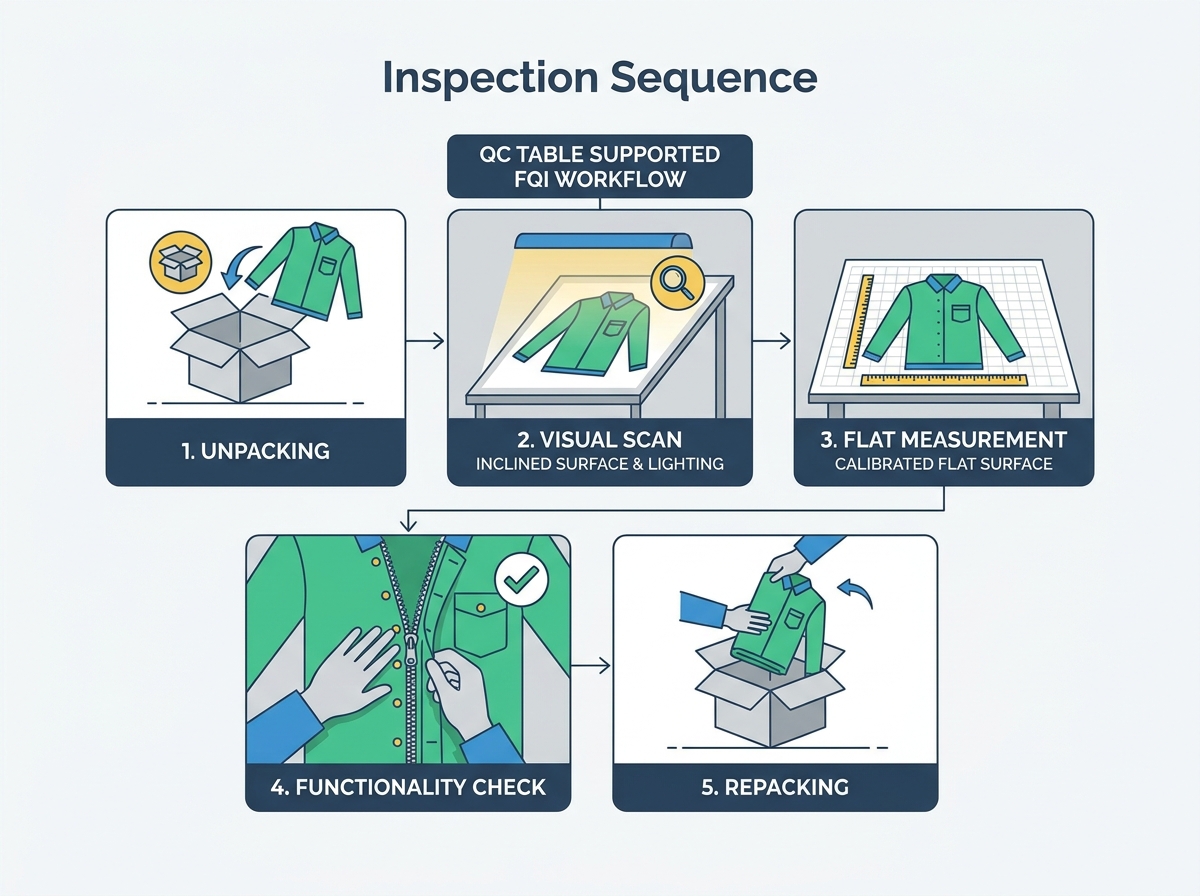
The physical table structure actively supports chronological FQI processes. A well-designed quality inspection table streamlines every procedural step. You can observe a standardized workflow utilizing the table's specific features.
Unpacking: Operators utilize the spacious flat section to unbox and sort garments quickly.
Visual scan on incline: Inspectors drape the garment over the 45-degree angled board to spot surface defects.
Flat measurement: The garment moves to the embedded grid surface to verify tech pack dimensional tolerances.
Functionality check: Inspectors test zippers, buttons, and snaps on the stable, reinforced lower deck.
Repacking: Approved garments slide into the packaging zone equipped with automated folding guides.
Modern workflows also demand seamless data integration. Space and mounts for digital tablets remain essential. IoT-enabled defect tracking systems need placement right at the inspection station. Digital data entry eliminates lost paper clipboards. It provides real-time defect analytics directly to production managers.
Equipment upgrades bring immense value but possess certain limitations. You must acknowledge these realities to maximize success.
A premium inspection station will not offset poor inspector knowledge. An inspector must understand a brand's specific defect classification manual thoroughly. The best lighting cannot help someone who cannot distinguish between a major and minor defect. Regular training sessions must accompany any equipment upgrades.
Common Mistake: Assuming new lighting automatically reduces defect rates.
Best Practice: Certify inspectors on brand-specific AQL manuals every six months.
These specialized tables demand strict, routine maintenance. Factory managers must schedule weekly lux meter checks. They must verify light intensity remains above the 1000-lux threshold. Surface cleaning prevents dirt transfer onto pristine white garments. Scratched acrylic panels or degraded LED bulbs immediately reduce the table's effectiveness. You must replace damaged components instantly.
Clean acrylic light boxes daily using non-abrasive microfiber cloths.
Calibrate embedded measuring grids annually against certified master rulers.
Stock spare D65 color-matching tubes to prevent production downtime.
Industrial tables require significant floor space. They need sufficient perimeter space for complex material handling. Trolleys, pallet jacks, and heavy export boxes must navigate around the station safely. Retrofitting large stations into cramped existing layouts requires careful floor planning. You might need to remove a sewing line to create an adequate FQI zone.
Upgrading your inspection infrastructure delivers immediate, measurable value to your facility.
Analyze the ROI: Reduced defect leakage and faster inspection cycles easily offset the initial capital expenditure. Preventing a single major buyer chargeback often pays for multiple professional tables.
Audit current bottlenecks: Determine if your primary issue is dimensional accuracy, visual oversight, or inspector fatigue. This audit dictates whether you prioritize light boxes, inclined boards, or perfectly flat beds.
Take action: Request exact lighting specifications, surface material data, and comprehensive warranty terms from equipment vendors. Test a single prototype unit thoroughly before ordering a factory-wide rollout.
A: Industry standards typically require a minimum of 1000 lux of shadow-free lighting at the inspection surface. Facilities often utilize D65 (daylight) color temperature bulbs. This specific standard ensures inspectors can accurately assess color matching and identify subtle shade variations.
A: While possible, they serve different operational needs. In-process (inline) tables are usually smaller and focused on specific component checks. Final inspection tables require much larger surface areas. They must accommodate fully assembled garments, complex packaging checks, and comprehensive measurement layouts.
A: An angled board allows the inspector to view the entire garment vertically without bending over. This angle proves critical for spotting silhouette distortions, overall symmetry, and major visual defects. Flat surfaces remain strictly reserved for precise dimensional measuring and final packaging verification.
A: They are not mandatory for heavy outerwear or denim. However, they are absolutely essential for lightweight, knit, or sheer garments. Bottom lighting detects tiny pinholes, uneven dyeing, and fabric density variations. Standard overhead lighting alone cannot reveal these specific structural flaws.


