

Views: 0 Author: Site Editor Publish Time: 2026-08-10 Origin: Site


In high-volume apparel manufacturing, precision dictates factory success. A degraded inspection environment correlates directly to disastrous false passes. Undetected defects slip past operators easily. Tiny flaws vanish when inspectors cannot see fabrics properly. Meanwhile, busy factory floors constantly generate airborne lint. Machinery produces heavy dust and constant vibration daily. These environmental factors quickly degrade sensitive measuring surfaces. They also ruin overhead lighting fixtures prematurely.
Minor daily wear accumulates into massive compliance liabilities rapidly. Consistent, documented maintenance requires much more than basic cleaning. It remains a fundamental requirement for factory operations. You must uphold strict Acceptable Quality Limit (AQL) standards. You need rigorous protocols to pass demanding third-party compliance audits. In this article, you will discover actionable daily maintenance steps. We will outline weekly calibration protocols and clear documentation strategies. You will learn how to keep equipment operating flawlessly.
Lighting Degradation: LED and fluorescent inspection lights lose lux intensity before burning out; schedule replacements based on hours of use, not just failure.
Surface Integrity: Abrasive cleaning degrades anti-glare and anti-static coatings on the quality control table, causing fabric snagging and measurement errors.
Audit Readiness: Third-party inspectors look for documented daily and weekly maintenance logs for physical inspection environments.
How does neglected equipment compromise garment classification? A compromised QC table directly skews AQL results. Scratched surfaces hide crucial fabric stains. Dim lighting obscures tiny weaving flaws. When inspectors miss these minor defects, whole shipments face rejection. Global brands demand absolute perfection from suppliers.
Consider the human element carefully. Long shifts induce severe inspector fatigue. Poorly leveled surfaces force operators into awkward postures constantly. Flickering overhead lights trigger severe headaches. These physical strains multiply human error rates exponentially. Ergonomics plays a massive role in defect detection accuracy. You must address physical discomfort proactively.
Audits introduce another massive operational risk. Major global brands follow strict ILO guidelines. They rely heavily on standardized ISO frameworks. Auditors demand highly verifiable documentation during visits. They inspect the physical inspection environment thoroughly. They want undeniable proof of regular upkeep. Without proper logs, factories fail compliance checks instantly.
What defines operational success? A properly maintained workstation hits specific physical benchmarks.
It delivers consistent 1000+ lux lighting across all functional zones.
The surface remains perfectly flat under heavy fabric loads.
It guarantees a smooth, zero-snag fabric handling experience.
Embedded measuring guides stay strictly calibrated against master tools.
Best Practice: Assign a dedicated supervisor to oversee daily environment checks. This ensures strict accountability across different shifts.
Common Mistake: Ignoring minor surface scratches. They eventually snag delicate fabrics and cause permanent garment damage.
Lint and debris management require relentless daily attention. Factory floors produce incredible amounts of fabric dust constantly. This dust settles quickly onto horizontal work surfaces. It easily masks minor garment stains during visual inspection.
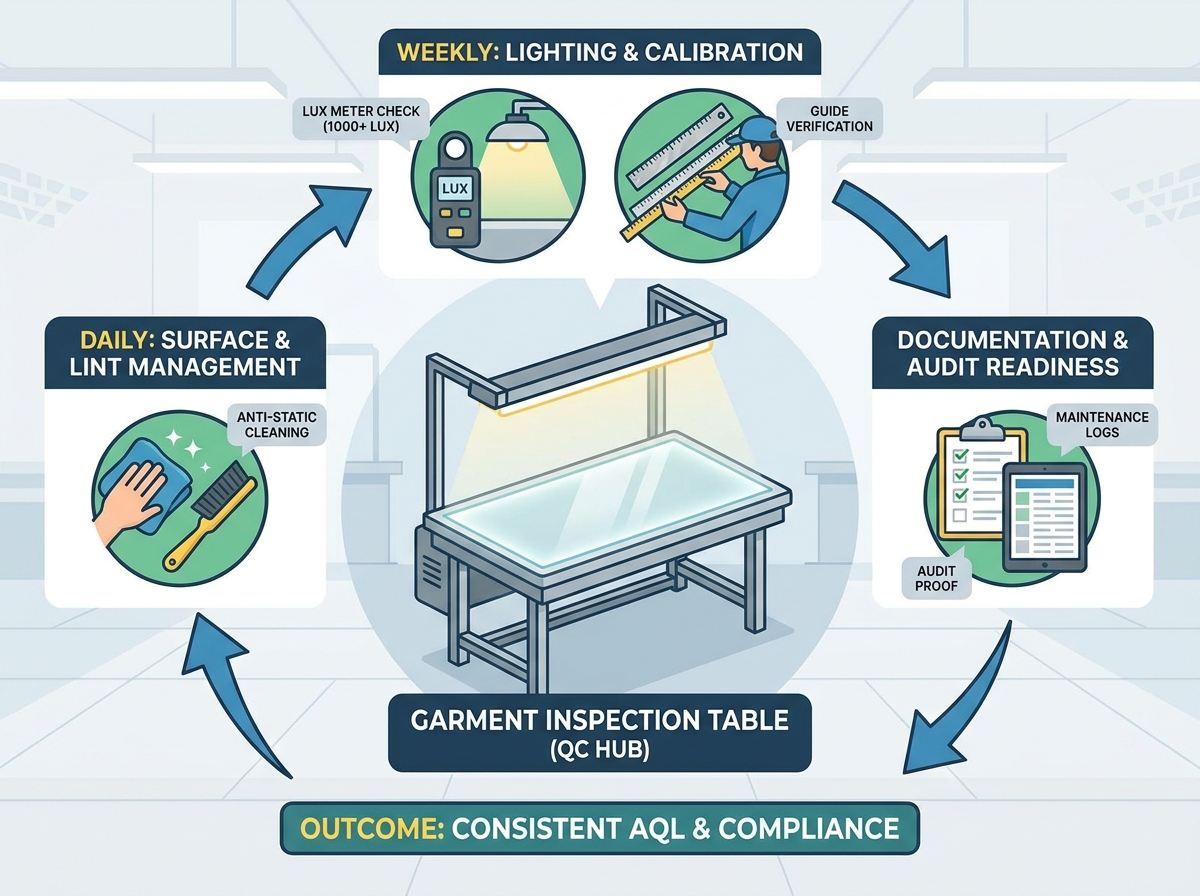
Operators must use anti-static brushes daily. They need lint-free microfiber cloths for routine surface wiping. They must gently sweep the entire working area beforehand. Preventing dust buildup protects the integrity of the inspection process.
Warning: Avoid harsh chemical solvents entirely. Ammonia-based cleaners strip away delicate frosted glass coatings. They destroy sensitive acrylic anti-glare layers permanently. The surface becomes highly reflective afterward. This unwanted glare strains inspector eyes quickly. It ultimately ruins defect visibility completely.
Measuring decal and guide calibration demand strict weekly routines. Rulers and measuring tapes embed directly into the work surface. They peel, fade, or stretch over continuous use. You must check them routinely against standard metrics.
Follow this standard operating procedure for guide calibration:
Clean the embedded measuring tape gently using a dry microfiber cloth.
Place a master calibrated metal ruler directly alongside the embedded guide.
Align the zero marks perfectly at the far starting edge.
Check every 10 centimeters for any material drift or stretching.
Document any deviations exceeding 1 millimeter immediately for correction.
Structural stability checks prevent critical measurement errors. Inspect the leveling feet carefully every single week. Check the locking casters regularly for debris buildup. The unit must remain strictly horizontal at all times. A slanted surface causes heavy fabrics to drift downward. This drift ruins precise dimensional checks. Operators struggle to measure garments accurately. Adjust the leveling feet until a bubble level reads perfectly centered.
Understanding the lighting lifecycle prevents sudden inspection failures. Inspection bulbs degrade significantly over continuous operation. They lose their Color Rendering Index (CRI) rating steadily. Their lux output drops long before they actually burn out. You must replace them proactively based on usage hours. Do not wait for complete electrical failure.
Top and bottom illumination serve distinctly different analytical purposes. A highly reliable quality inspection table relies on dual lighting systems.
Under-lighting highlights fabric flaws vividly. It reveals tiny holes and subtle weaving defects clearly. Glass or acrylic surfaces contain internal light diffusers. You must clean dust from these internal diffusers monthly. Trapped dust blocks light and creates uneven bright spots.
Overhead lighting requires D65 daylight standard bulbs always. These specialized bulbs simulate natural sunlight perfectly. They ensure accurate color matching across different dye lots. You must keep the overhead fixtures completely free of heavy factory lint.
Testing protocols guarantee standard compliance. You must use a calibrated lux meter weekly. Ensure the station maintains minimum required illumination constantly. This usually means 1000 to 1500 lux across the entire surface.
Many factories make a critical error here. They only test the exact center of the surface. You must test all four outer corners as well. The edges often suffer from severe light drop-off.
Review this comparison chart regarding standard lighting zones:
Inspection Zone | Minimum Required Lux | Primary Detection Goal | Recommended Testing Frequency |
|---|---|---|---|
Center Focal Area | 1500 Lux | Stains, color shading, fine stitching errors | Weekly |
Peripheral Edges | 1000 Lux | Seam alignment, dimensional measurements | Weekly |
Under-lighting (Diffused) | 800 Lux | Weaving defects, fabric tears, pinholes | Bi-weekly |
Creating a comprehensive maintenance log establishes clear operational control. You should design a simple, intuitive checklist immediately. Attach it directly to the physical workstation frame. This visibility reminds operators of their daily duties. Digital tablets mounted nearby also work exceptionally well. They timestamp entries automatically for better compliance tracking.
Assigning strict accountability prevents tasks from slipping away. Clear roles ensure highly consistent execution.
Operators handle daily surface preparation duties. They brush away lint before their shift begins. They wipe down the anti-glare glass gently. They report any immediate physical damage upward.
Maintenance and facilities teams handle deeper weekly checks. They manage complex calibration tasks. They perform crucial electrical safety inspections. They replace degrading bulbs safely during off-hours.
Evidence-oriented tracking satisfies strict third-party QA auditors. Auditors look for unbroken chains of maintenance documentation. You must log bulb replacement dates clearly. You must record exact lux meter readings weekly. You should file surface condition reports monthly. These documents serve as definitive proof of operational control. They demonstrate your deep commitment to quality environments.
Maintenance Task | Responsible Role | Frequency | Required Audit Evidence |
|---|---|---|---|
Surface Debris Sweeping | Line Operator | Daily (Pre-shift) | Initialed Daily Checklist |
Lux Meter Testing | QA Supervisor | Weekly | Recorded Lux Values Log |
Measuring Guide Calibration | Maintenance Tech | Weekly | Deviation Variance Report |
Diffuser Cleaning | Facilities Staff | Monthly | Signed Service Ticket |
Evaluation criteria focus strictly on operational downtime and physical wear. You must assess when constant repairs outpace standard upkeep. Aging units cause frustrating production delays. They disrupt factory flow constantly.
Watch closely for signs of terminal wear. A deeply scratched viewing glass ruins the entire inspection process. Warped glass causes unpredictable, harsh glare. It snags delicate garments constantly during handling. Failing internal wiring poses a severe electrical safety hazard. Non-modular lighting fixtures become utterly impossible to service efficiently.
Fixed-height frames present another terminal structural issue. They cause repetitive strain injuries (RSI) among busy inspectors. Ergonomic limitations lead to high employee turnover rates. When a station physically harms operators, you must discard it immediately.
Procurement considerations guide your next equipment upgrade. Modernize your inspection floor thoughtfully. Look for specific industrial features when selecting a new quality control table.
You need modular components for rapid servicing. Tool-less bulb replacement saves hours of frustrating maintenance time. Durable anti-static powder coating repels heavy factory dust naturally. Integrated ergonomic tilt mechanisms protect inspector posture actively.
Avoid units utilizing glued acrylic surfaces. They warp under continuous factory heat. Select stations featuring tempered, frosted glass instead. They withstand harsh industrial environments far better. They maintain their flat physical profile indefinitely.
Maintaining a garment inspection station requires relentless consistency. It remains an ongoing process of dedicated surface care. You must perform rigorous lighting calibration routinely. You need highly organized documentation to prove your compliance.
Factories must shift their internal mindset entirely. You must treat your inspection stations as precision testing instruments. They are never just basic factory furniture. They dictate the accuracy of your entire quality assurance program.
Evaluate your current equipment against international compliance standards today. Download our comprehensive daily maintenance checklist for your operators. Review our catalog of high-durability, low-maintenance stations. We design them specifically for heavy industrial apparel manufacturing use.
A: Do not wait for burnout. Replace based on manufacturer-rated lifespan (e.g., every 12-18 months for high-use fluorescent, or when lux meter readings drop below 1000). Proactive replacement prevents inspection errors caused by degraded illumination.
A: Use isopropyl alcohol solutions and lint-free cloths; avoid abrasive sponges or ammonia-based cleaners that cause micro-scratches. Gentle wiping motions protect the specialized anti-glare and anti-static surface treatments effectively.
A: Often due to worn-out anti-static mats or poor grounding. Check the grounding wire connection and ensure daily cleaning isn't using static-generating materials. Dry factory environments often worsen this static buildup significantly.


