

Views: 0 Author: Site Editor Publish Time: 2026-08-10 Origin: Site


Final inspection represents the absolute last line of defense before a shipment leaves your factory floor. Equipment failures at this critical stage cause disastrous results. They lead directly to buyer chargebacks, Acceptable Quality Limit (AQL) failures, and severe brand damage. You simply cannot afford to guess when lucrative international orders are on the line.
Inline inspection often relies on rapid visual checks as garments move down the production line. However, the end-line station operates differently. It requires standardized, highly calibrated equipment to ensure an objective quality assessment. Operators need the right tools to identify subtle fabric defects consistently. They must isolate issues before goods pack into export cartons.
This guide breaks down the essential equipment required to configure a compliance-ready final inspection station. We start by examining the foundational setup elements. We then move through critical diagnostic tools and lighting requirements. You will learn exactly how to build a reliable, professional workstation from the ground up.
The centerpiece of any effective setup is a purpose-built **QC table** designed to minimize operator fatigue and standardize visual checks.
Proper illumination (minimum 1,000 lux, D65 color temperature) is a non-negotiable compliance requirement, not an optional upgrade.
Measurement and diagnostic tools must be subject to a strict calibration schedule to maintain authoritative data integrity.
Station layout must physically separate "Pass," "Fail," and "Hold" garments to prevent accidental mixing.
Relying on makeshift workstations creates severe operational bottlenecks. Operators struggle to identify defects consistently on poorly designed surfaces. They experience physical fatigue during long shifts. This exhaustion leads directly to subjective grading and missed flaws. Unreliable setups damage buyer trust very quickly.
A finalized station must solve these exact problems. It must enable fast, safe garment manipulation. It should provide undeniable proof of defects through standardized lighting and exact measurements. Furthermore, the setup must support secure data entry directly into your digital tracking systems. Objective data protects your margins during vendor disputes.
Top-tier buyers view inspection equipment through a strict compliance lens. Third-party agencies like Intertek or SGS evaluate your physical setup meticulously. They reference standards like ISO 2859-1 for sampling procedures. They require specific equipment configurations before they will certify an internal process. Standardized equipment proves your commitment to objective quality control.
Financial penalties hit hard when defective garments reach foreign ports. Buyers demand immediate chargebacks for unsellable inventory. They often force factories to pay exorbitant airfreight costs for replacement units. An optimized inspection station prevents these catastrophic financial losses entirely.
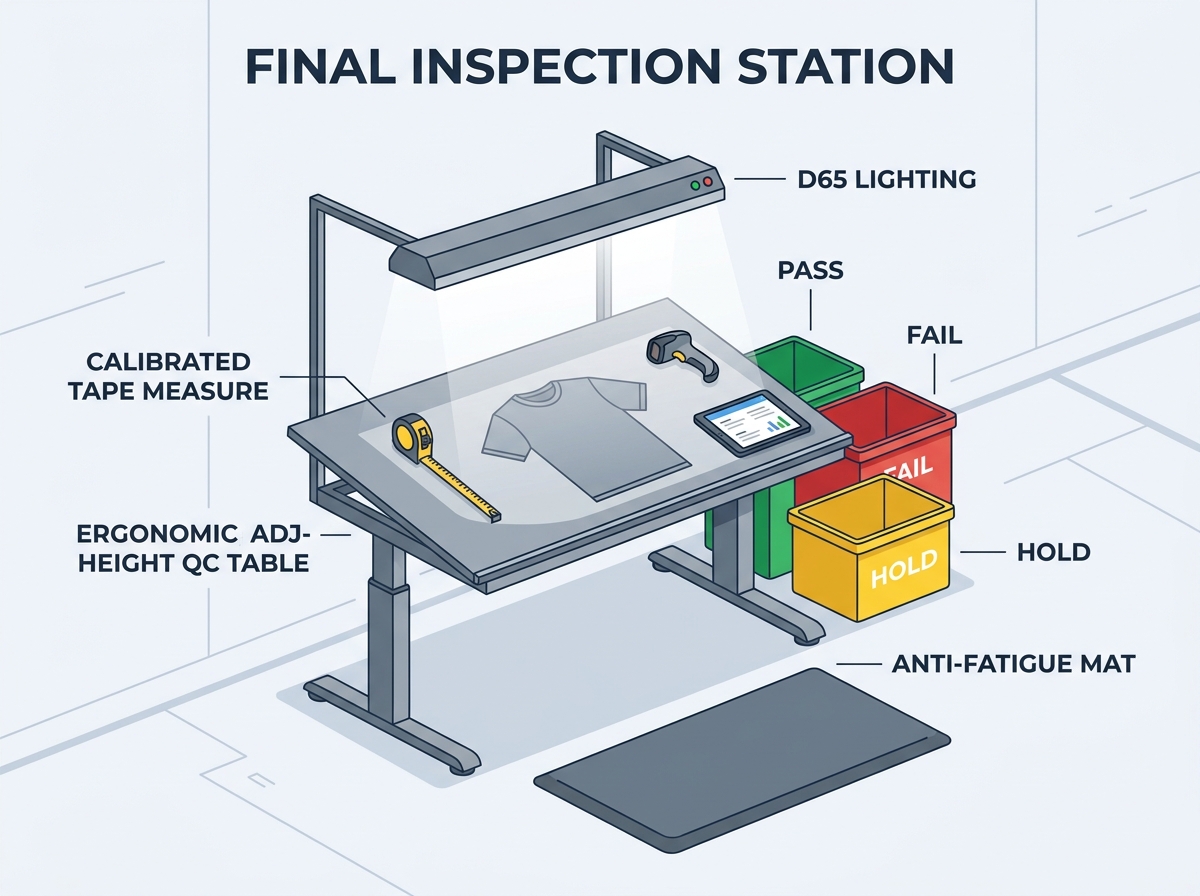
The physical anchor of any professional station is the QC table. It dictates how efficiently an operator can handle bulky products. Selecting the wrong dimensions instantly bottlenecks the workflow. Choosing improper surface materials causes irreversible garment damage.
You must evaluate several critical dimensions when selecting this core asset. Each element plays a distinct role in daily operations. Do not rush this procurement step.
Surface Material: The tabletop must be entirely smooth and anti-static. It should feature a non-reflective matte finish. This prevents delicate fabric snagging. It also reduces eye-straining glare under high-intensity overhead lights. Melamine or industrial-grade laminates work exceptionally well here.
Dimensions & Angle: Operators need sufficient width to lay the largest manufactured garment completely flat. Adjustable tilt mechanisms are equally critical. A tilt between 15 and 45 degrees allows for highly ergonomic visual scanning. Operators can inspect seams without excessive neck strain.
Integrated vs. Standalone: You must evaluate your specific fabric types. Built-in light boxes help operators check fabric density easily. They also expose hidden seam defects. Basic flat surfaces work better for opaque, heavy-duty textiles like denim.
Weight Capacity: Industrial stations endure constant physical stress. The frame must support heavy garment bundles securely. It cannot bow, wobble, or lose stability over time. Reinforced steel legs offer the best long-term stability.
Never use untreated metal or rough wood for garment inspection surfaces. Stainless steel creates excessive static electricity. Raw wood causes disastrous fabric snags. Always insist on premium sealed materials. These ensure garments glide smoothly during rapid handling.
Component | Standard Requirement | Impact on Inspection |
|---|---|---|
Surface Finish | Matte, anti-static coating | Prevents glare and stops dust attraction |
Tilt Angle | 15° to 45° adjustable | Reduces operator neck and back fatigue |
Load Capacity | Minimum 150 kg (330 lbs) | Safely holds bulk winter coats and heavy bundles |
Standard factory overhead lighting creates a massive problem for final inspectors. Ambient light fluctuates drastically throughout the day. It distorts true fabric colors badly. These daily fluctuations make stain detection nearly impossible. Spotting subtle shade variations becomes pure guesswork.
You must implement strict technical lighting requirements to pass agency audits. Assessors check these specific metrics on day one.
Illuminance: You need a minimum of 1,000 lux hitting the table surface directly. Use a calibrated lux meter weekly to verify this output. Light tubes degrade over time.
Color Temperature: D65 standard daylight bulbs are absolutely mandatory. They ensure accurate color evaluation against official Pantone shade standards. Replace them every 2,000 hours of use regardless of visual brightness.
Ergonomics play an equally vital role in defect detection rates. A rigid setup forces uncomfortable postures. You should prioritize an adjustable height quality inspection table. It accommodates different operators across multiple shift changes. It allows them to alternate easily between sitting and standing.
If operators must stand, you must provide commercial-grade anti-fatigue floor mats. These mats reduce lower limb stress significantly. Comfortable inspectors maintain high concentration levels during exhausting ten-hour shifts.
Lighting Source | Lux Output | Color Rendering Index (CRI) | Compliance Status |
|---|---|---|---|
Standard Factory Fluorescent | 300 - 500 | Low (60 - 70) | Fail |
Consumer LED Tubes | 600 - 800 | Moderate (80) | Fail |
D65 Standard Daylight Bulbs | 1,000+ | High (95+) | Pass |
Visual checks mean very little without objective measurement tools. You must back up every defect claim with verifiable data. Evidence-oriented processes help you defend against costly buyer disputes effectively. Clear data separates professional factories from amateur operations.
Every compliance-ready station requires a specific diagnostic toolkit. Missing even one item compromises your entire inspection integrity. Supervisors must audit these tools daily.
Calibrated Tape Measures: Use steel or non-stretching fiberglass tapes only. You must routinely check them against a certified master metal ruler. This strict routine prevents hidden sizing drift.
Defect Indicators: Supply standardized arrow stickers or brightly colored tags. They mark exact defect locations clearly for rework teams. They must pass chemical tests to ensure they never leave adhesive residue.
Color Standard References: Keep approved physical shade bands nearby. Keep authentic Pantone books at the station. Store them away from direct sunlight immediately after use. This discipline prevents rapid UV fading.
Magnifying Pick Glasses: Inspectors need high-quality optical magnifiers. These tools allow them to verify yarn counts accurately. They also help identify broken stitches at a microscopic level. Buy magnifiers featuring built-in LED illumination for optimal clarity.
Barcode Scanners & Tablets: Digitize your workflow completely. These smart devices allow immediate, error-free data entry. They sync directly into your factory Quality Management System (QMS).
Factories often stumble during the actual rollout phase. They buy excellent equipment but fail to manage the surrounding environment. Clutter and cross-contamination represent severe daily risks. You must prevent accidental inventory mixing at all costs.
Failing to provide designated, clearly marked sorting bins ruins data integrity. You need separate racks for "Accepted," "Rejected," and "Rework" garments. Place them right next to the station. Without these distinct zones, operators mix passing and failing items easily. Implement 5S methodology to keep the area organized.
Ignoring tool degradation is another massive pitfall. Operators often keep using stretched measuring tapes out of pure habit. They rely on expired lighting tubes because the bulbs still emit light. However, D65 tubes lose their specific color accuracy long before they actually burn out. You must mandate strict replacement schedules.
Digital integration failures also derail factory upgrades frequently. Managers buy expensive tablets but fail to provide robust Wi-Fi at the station. Operators revert to paper forms when digital connections drop. Ensure your IT department guarantees strong network coverage around every inspection area.
Finally, factories often fall into the trap of over-engineering. They purchase overly complex automated systems unnecessarily. A modular, ergonomically sound mechanical quality control table usually serves high-mix operations much better. Keep the design simple, highly durable, and intensely functional.
You need a structured approach to upgrade your inspection floor. Random equipment purchases lead to mismatched, non-compliant stations. Follow a systematic process to procure the right tools effectively.
Start by auditing your current inspection areas. You need to identify the primary source of false passes. Ask operators direct questions about their daily struggles. Are they fighting dim lighting? Is cramped space causing workflow jams? Are critical diagnostic tools missing during peak hours?
Next, apply strict vendor selection criteria. Prioritize equipment suppliers who truly understand international compliance standards. They must provide official certifications for their lighting setups. They should also supply verified calibration documentation for all provided measurement tools.
Consider the long-term maintenance requirements before signing purchase orders. Ask vendors about spare parts availability. Can you source replacement D65 bulbs locally? Do they offer extended warranties on the table frames? Reliable aftermarket support keeps your inspection lines running smoothly year after year.
Here are the actionable next steps to initiate your upgrade smoothly:
Draft a comprehensive Bill of Materials (BOM) for a single test station.
Order exactly one complete setup to serve as your testing prototype.
Run a two-week pilot program to gather direct operator feedback.
Refine the table height, bin placement, and tablet mounts based on their input.
Roll out the finalized, standardized setup across the entire factory floor.
Setting up a highly effective final inspection station requires much more than a flat surface. It demands a systematic, thoughtful approach to lighting, ergonomics, and calibrated measurement. Every component must work together seamlessly to support the human operator.
Investing in a professional-grade setup actively removes human subjectivity from your quality control process. You establish a defensible, objective standard. This ultimately protects your business margins by catching critical defects long before they ever reach the shipping dock.
Take action today to secure your quality pipeline. Request a formal quote for standardized inspection stations from a certified supplier. Download a comprehensive station setup checklist to audit your factory floor. Contact an equipment specialist to schedule a full facility review.
A: Typical industrial units measure approximately 72 inches by 36 inches. However, the exact size must accommodate the largest item your factory manufactures when laid completely flat. Standardizing this size ensures operators never have to fold garments during visual checks, which hides critical defects.
A: Industry standards require operators to verify flexible tape measures daily against a master metal ruler. Formal, documented calibration audits should occur monthly. Replace any fiberglass or vinyl tapes immediately if they show more than a 1/8-inch stretch to maintain AQL integrity.
A: No. Consumer LEDs often suffer from low Color Rendering Indexes (CRI) and fluctuating color temperatures. Compliance requires specialized D65 color-matching tubes. These bulbs replicate standard daylight exactly, ensuring your physical color evaluation strictly matches approved buyer Pantone standards.


