


Views: 0 Author: Site Editor Publish Time: 2026-08-03 Origin: Site


The physical workstation is often the most overlooked variable in garment quality assurance. A missed defect or inaccurate Point of Measurement (POM) rarely happens solely due to human error. Instead, it happens because the inspector's environment does not optimally support visual and physical evaluation. Upgrading from a standard workbench to a purpose-built QC table represents a vital operational investment. This upgrade directly impacts defect catch rates, throughput speed, and inspector fatigue.
Without proper equipment, even highly trained personnel will miss critical flaws during long shifts. This guide breaks down the essential features you should look for when evaluating an inspection station. We translate physical specifications directly into measurable operational outcomes. You will learn exactly how lighting, ergonomics, and specific surface materials influence your daily Acceptable Quality Limit (AQL) results.
Lighting is the critical differentiator; look for dimmable overhead LEDs with a high Color Rendering Index (CRI) and optional under-surface illumination for fabric transparency checks.
Ergonomics directly impact inspection accuracy. Adjustable height settings reduce physical strain during high-volume shifts.
A true QC table integrates measurement grids, neutral-colored, non-abrasive surfaces, and tool organization to support rigorous AQL (Acceptable Quality Limit) procedures.
Evaluating a table requires balancing standardized features with modular add-ons (e.g., tablet mounts, defect bin storage) based on your specific garment categories.
Quality assurance teams face immense pressure to evaluate garments quickly and accurately. Utilizing inadequate equipment creates a foundational bottleneck. A standard warehouse desk simply lacks the specific engineering required for textile inspection. When you rely on basic furniture, you introduce unacceptable risks into your AQL processes.
Poor lighting and cramped spaces actively generate costly errors. Inspectors working under standard fluorescent ceiling lights struggle to see subtle dye variations. They miss loose threads hidden in shadows. This environment inevitably leads to false passes. You end up shipping defective garments to your customers. Your brand reputation suffers immediate damage.
Conversely, inadequate equipment also causes false fails. Inconsistent lighting can make acceptable seam puckering look like a critical defect. You reject perfectly good products. You waste valuable inventory and slow down your supply chain. An optimized quality control table eliminates these environmental variables.
Basic warehouse tables use rough laminates or unfinished edges. These surfaces easily snag delicate textiles like silk or lightweight knits. A specialized workstation utilizes ultra-smooth, non-abrasive edges. Standard desks also create severe lighting shadows. Inspectors must constantly physically rotate garments to see every angle. This wastes time and introduces manual handling risks.
Workstation Comparison Summary
Feature | Standard Warehouse Desk | Specialized Inspection Workstation |
|---|---|---|
Surface Material | Basic wood or rough laminate | Matte, anti-snag, anti-static composite |
Lighting | Relies on ambient facility lights | Integrated, high-CRI, adjustable LEDs |
Measurement Tools | Requires external measuring tapes | Embedded, wear-resistant surface grids |
Ergonomics | Fixed height, causes strain | Sit-to-stand adjustable mechanisms |
Frame this equipment purchase purely as an ROI decision based on operational metrics. Measure success through increased daily inspection volume. Track the reduction in ergonomic injury complaints from your team. Monitor your precision in POM checks. When inspectors stop wrestling with bad lighting and external measuring tapes, their efficiency skyrockets. They hit their daily quotas without sacrificing precision.
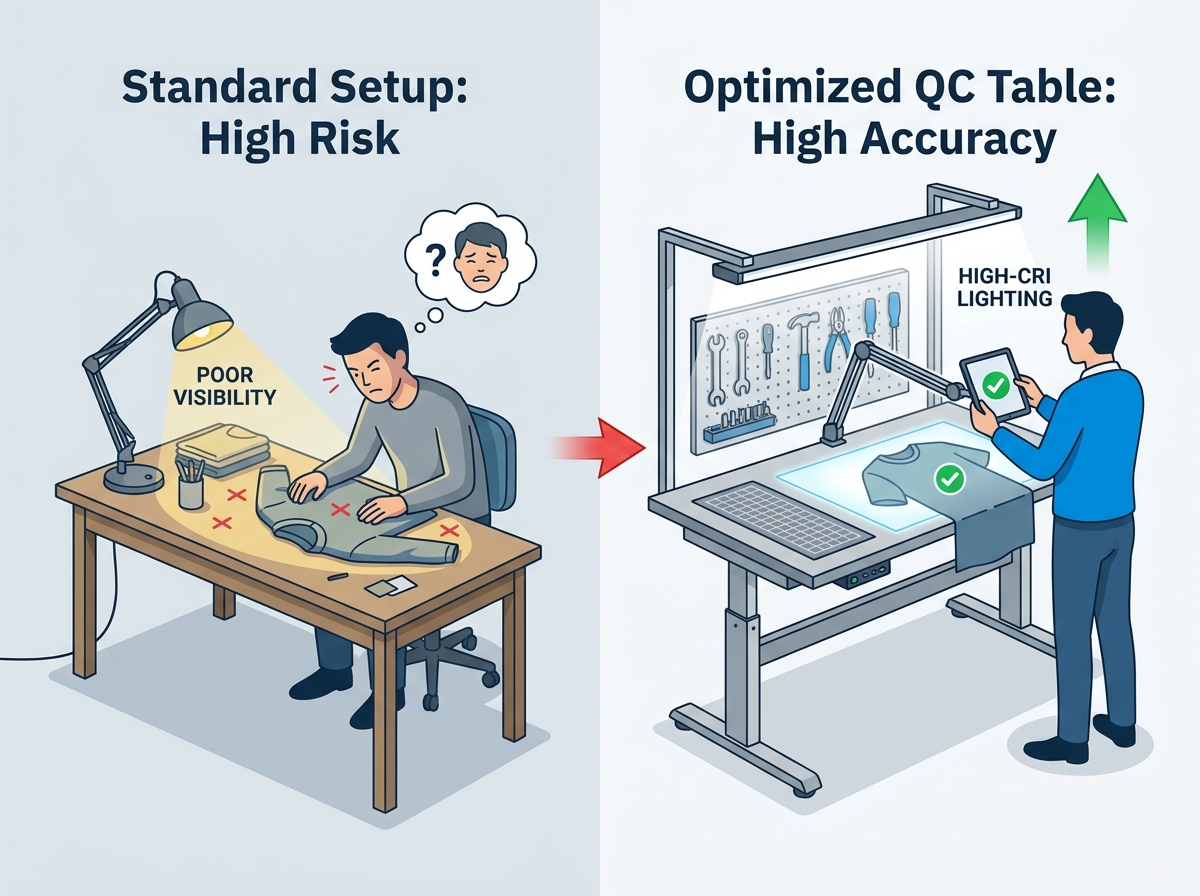
You must evaluate any quality inspection table across several technical dimensions. Form must follow function. Every physical attribute should directly solve a specific inspection challenge.
Lighting remains the most critical feature of any inspection environment. Proper illumination dictates an inspector's ability to spot minor flaws before packaging.
Overhead Lighting: The workstation must feature daylight-balanced LEDs. Look for color temperatures between 5000K and 6500K. These bulbs replicate natural sunlight. More importantly, require a high Color Rendering Index (CRI). The CRI must exceed 90. A high CRI ensures accurate color matching. It allows inspectors to perform precise shading analysis. They can easily distinguish between navy blue and black.
Under-Surface Illumination: Standard top-down lighting cannot reveal internal garment structures. Many workstations include a frosted glass section housing under-surface lights. Use this feature to inspect fabric density. You can quickly spot weaving flaws or uneven yarn distribution. It also highlights seam integrity. This tool is absolutely essential for evaluating lightweight, sheer, or technical fabrics.
Adjustability: Lighting intensity must remain flexible. Dimmable options are mandatory. Inspecting highly reflective materials under maximum brightness causes severe glare. Glare blinds the inspector and hides surface defects. Dimmers allow your team to adjust illumination based on the specific synthetic material they handle.
The table surface directly interacts with your product. A poorly designed surface damages garments and slows down the inspection routine.
Neutral, High-Contrast Color: Surface color significantly influences human visual perception. The table surface should feature a matte finish. Avoid glossy laminates entirely. Glossy surfaces reflect overhead light into the inspector's eyes. Choose a neutral gray (like Munsell N7) or a pure matte white. Neutral backgrounds prevent color distortion. They make loose dark threads or faint stains highly visible against the surface.
Built-in Measurement Grids: Measuring POMs consumes a massive portion of inspection time. Eliminate external measuring tapes. Seek out surfaces containing embedded, wear-resistant measurement scales. These grids should display both centimeters and inches. Inspectors simply lay the garment flat to verify dimensions instantly. This rapid verification drastically improves daily throughput.
Anti-Snag & Anti-Static (ESD) Properties: Table edges must feature perfectly smooth, rounded banding. Sharp corners snag delicate knits, sheer silks, and intricate lace. Furthermore, modern garments often incorporate technical fabrics or wearable electronics. Inspecting these items generates static electricity. Anti-static (ESD) surface properties safely dissipate this charge. They protect both the garment and your testing equipment.
Industrial inspection involves heavy physical labor. The furniture must withstand constant, rigorous use.
Vibration Reduction: Inspectors constantly pull, stretch, and flip fabrics. A flimsy aluminum frame will wobble continuously. This wobbling disrupts careful measurements. It also causes eye strain when viewing small details under magnification. Require a heavy-duty, welded steel frame. Solid frames dampen vibration and keep the work surface completely steady.
Weight Capacity: Apparel inspection often involves bulk handling. The surface must safely support heavy, continuous rolls of fabric. It must also handle large bulk stacks of winter garments or heavy denim. A high weight capacity prevents the center of the table from bowing over time. Bowed tables ruin the accuracy of flat POM measurements.
Human fatigue directly causes missed defects. As an inspector's physical strain increases, their visual acuity drops. Designing for ergonomics protects your AQL integrity.
Fixed-height tables force inspectors into unnatural postures. Over an eight-hour shift, this leads to severe discomfort and declining focus.
Sit-to-Stand Capability: Premium workstations incorporate adjustable height mechanisms. You can choose manual hand cranks or motorized electric lifts. Adjustability allows inspectors to alternate between sitting and standing postures freely. Changing positions drastically reduces back, neck, and shoulder fatigue. A comfortable inspector remains an accurate inspector throughout their entire shift.
Focal Length Optimization: Inspectors come in all different heights. A fixed table forces taller individuals to hunch over. It forces shorter individuals to overextend their arms. Adjustable heights allow every user to optimize their focal length. They can maintain the correct visual distance from the garment. Optimized focal distances drastically reduce eye strain during minute detail checks.
A cluttered workspace actively slows down the inspection process. Organization and digital readiness define modern quality control.
Tool Organization: Inspectors require immediate access to various instruments. Look for workstations featuring built-in shelving or vertical pegboards. These storage solutions hold fabric shears, pick glasses, and pantone books safely. They also provide space to display standardized defect charts. Keeping tools off the main surface maximizes the active inspection area.
Digital QC Readiness: Paper-based reporting is obsolete. Modern teams use digital QC software. The workstation must support this technology. Seek out articulating arm mounts for tablets or laptops. Integrated power strips are crucial. They keep devices fully charged without running dangerous extension cords across the warehouse floor. Real-time data entry speeds up overall reporting workflows.
Segregation Bins: Preventing cross-contamination is a fundamental QA principle. Insist on under-table or side-mounted segregation bins. Use them to separate inspected items immediately. Implement a clear sorting system:
Pass: Garments ready for final packaging and shipping.
Rework: Items requiring minor fixes, like snipping long threads.
Reject: Defective garments requiring permanent disposal or factory return.
Physical separation prevents defective garments from accidentally mixing back into approved inventory batches.
Choosing the right manufacturing partner ensures a smooth implementation. You must evaluate suppliers on compliance, reliability, and delivery logistics.
Custom vs. Standardized Models: First, assess your specific garment categories. Standardized dimensions work perfectly for basic apparel like t-shirts and trousers. However, you might process large textiles like bridal gowns or heavy outerwear. In these cases, standardized tables prove too small. You will need to specify a custom, bespoke size to accommodate larger garment drapes.
Compliance & Safety: Inspection workstations contain integrated electrical components. You must ensure all lighting fixtures and power outlets meet regional safety standards. Look for CE marks in Europe or UL listings in North America. Electrical compliance is non-negotiable for warehouse safety protocols.
Warranty and Replacement Parts: Industrial environments degrade equipment over time. Look for suppliers offering robust warranties. Pay special attention to the longevity guarantees for LED drivers. Ask about the durability testing for surface laminates. Ensure the supplier stocks accessible replacement parts for quick repairs.
Implementation Risk: Finally, consider the logistical realities of delivery. Heavy steel workstations incur high shipping costs. Verify accurate lead times to prevent facility delays. Review the assembly requirements carefully. Does the unit arrive fully assembled? Does it require specialized tools to build? Will you need to hire a certified electrician to wire the integrated lighting? Answer these questions before signing a purchase order.
A garment quality control table acts as a highly specialized industrial tool. It is never just a piece of standard warehouse furniture. This equipment bridges the vital gap between your documented QC standards and your actual shop-floor execution. When you provide the right environment, your inspectors perform at their absolute best.
Actionable Next Steps:
Prioritize high-CRI lighting systems over aesthetic design features.
Invest heavily in ergonomic adjustability to sustain inspector focus during long shifts.
Audit your current workstations to identify shadow zones and snagging hazards.
Consult with your inspection team to map out their specific tool storage needs.
Request a customized quote for a purpose-built inspection station tailored to your garments.
A: Table sizes vary significantly based on your specific application. Generally, a 72" x 36" (180cm x 90cm) surface serves as the industry standard for typical tops and bottoms. However, if you inspect larger pieces like gowns or coats, you will require 96" (240cm) widths to prevent garments from dragging on the floor.
A: Under-table lighting is not strictly necessary for opaque, heavy materials like denims or thick leathers. However, we highly recommend it for inspecting knits, activewear, and sheer fabrics. The under-surface illumination allows inspectors to spot microscopic weaving inconsistencies and yarn density flaws instantly.
A: We recommend a matte, neutral grey (specifically Munsell N7) or a bright matte white. These specific neutral tones prevent color reflection. They ensure the background does not skew the inspector's visual perception of the garment's true dye color during shading checks.
A: Ergonomic features directly reduce physical fatigue and eye strain. Exhaustion remains the primary cause of human error. By allowing posture changes and optimizing focal lengths, inspectors maintain high concentration levels. This prevents them from missing subtle defects during the final, challenging hours of an inspection shift.


