

Views: 0 Author: Site Editor Publish Time: 2026-08-08 Origin: Site


Many facility managers treat fulfillment and inspection workstations as identical assets. You buy a sturdy bench, install an overhead light, and call the job complete. This common procurement oversight causes severe hidden damage across your daily operations. Misaligned workstation selection creates massive fulfillment bottlenecks in busy warehouses. Worse, it compromises critical defect detection capabilities in sensitive manufacturing environments. You also risk wasting capital on incorrect or over-engineered specifications. We will provide an objective, criteria-driven framework to solve this challenge. Operations managers can use this guide to evaluate, specify, and invest wisely. You will learn to match the correct industrial workstation to your specific workflow, ensuring maximum efficiency.
Distinct Functions: Packing tables optimize for throughput, packaging material storage, and dispatch logistics; QC tables prioritize precision, regulatory compliance, and instrument stability.
Material & Environmental Control: A dedicated quality control table often requires specialized surface treatments (like ESD protection or chemical resistance) that standard packing stations lack.
Ergonomics & Tech: Quality inspection tables require high-CRI lighting, magnification, and rigid mounts for testing peripherals, whereas packing tables focus on barcode scanners, scales, and dimensional weight (DIM) systems.
Strategic Separation: Combining both functions on one table introduces contamination risks and lowers accuracy for complex or sensitive manufacturing.
A workspace must adapt perfectly to the physical actions performed there. Standardizing a single bench design across wildly different departments remains a costly mistake. Let us break down the primary definitions to understand their specific operational roles.
We define the packing table by its sheer spatial efficiency. It caters strictly to outbound logistics and warehouse dispatch. Operators at these stations focus on rapid, dynamic physical movements. They gather items, fold boxes, insert void-fill, seal cartons, and print shipping labels.
Its core components reflect this speed-focused goal completely. You will typically find corrugated carton storage racks mounted overhead. Heavy-duty roll holders dispense bubble wrap or kraft paper seamlessly during the shift. Many premium units feature integrated scale cutouts. These precise cutouts allow heavy boxes to slide smoothly across the surface without lifting. Ergonomic mounts keep label printers and scanners within comfortable arm's reach.
The primary KPI supported here is raw throughput. Warehouse managers measure success by packages processed per hour. The secondary operational goal involves reduced operator motion. Minimizing walking steps dramatically speeds up the overall dispatch line.
We define this workstation quite differently from a logistics bench. It requires a highly controlled, stable environment. Assessors use it for rigorous defect detection and final product verification. Accuracy always matters significantly more than raw processing speed.
Core components focus entirely on measurement precision. You need high-visibility task lighting to spot minute manufacturing flaws. You need vibration-dampening frames to ensure complete instrument stability. Heavy-duty monitor arms support complex software displays. Specialized testing jigs secure delicate products during manual evaluation.
This is where a dedicated QC table shines for manufacturing teams. Its primary KPI is the absolute defect catch rate. The workstation also ensures strict compliance adherence before shipping. Skipping these precision features risks major product failure downstream.
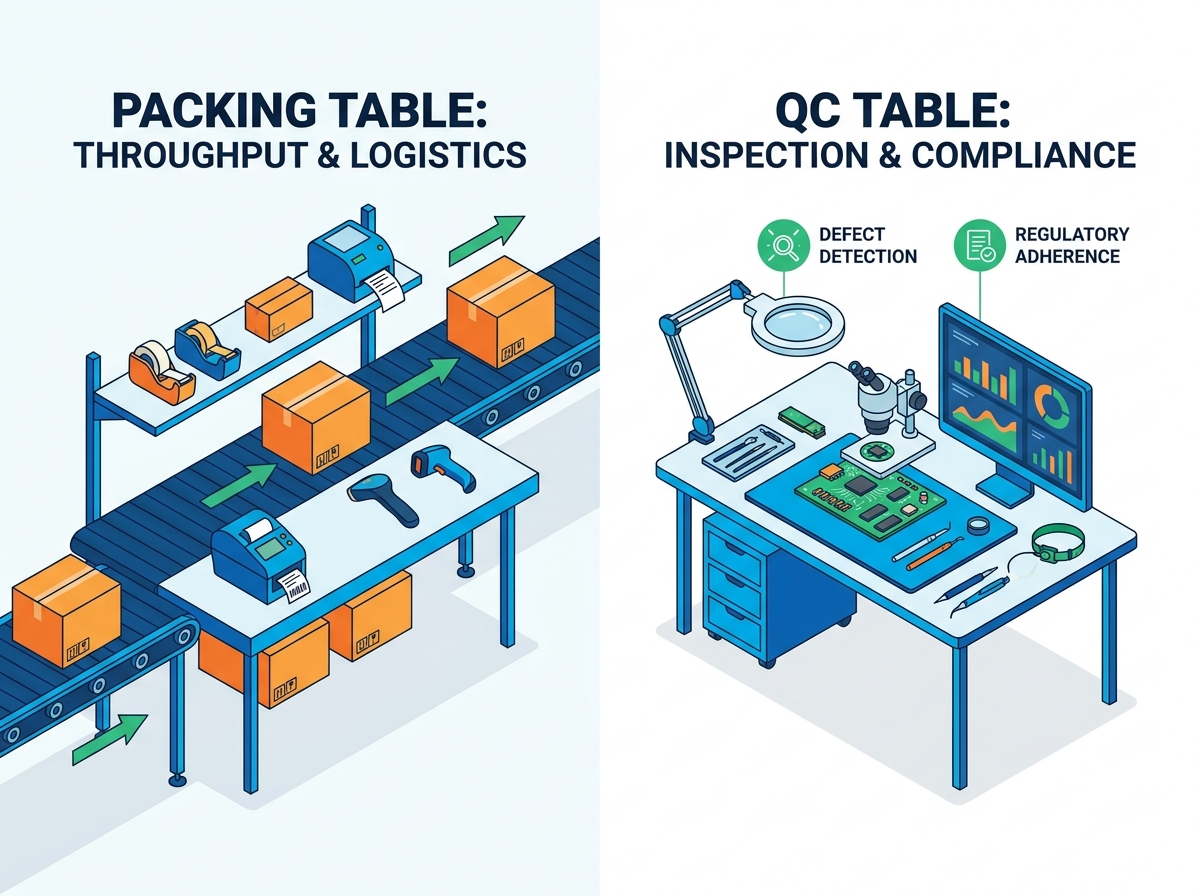
You cannot simply swap daily tasks between these two distinct benches. Their foundational hardware requirements differ fundamentally. We detail four major structural and design differences below.
Packing benches usually feature standard laminate, butcher block, or basic wood tops. They handle rough cardboard, heavy tape, and thick plastic wrap. Conversely, a quality inspection table often demands highly specialized surface treatments. Handling sensitive electronics or sterile medical goods requires strict industry compliance.
You often need ESD-safe (Electrostatic Discharge) worktops. These conductive surfaces dissipate static charges safely into the ground. Alternatively, pharmaceutical testing environments require grade 304 or 316 stainless steel. These non-porous surfaces resist harsh chemical cleaners and prevent dangerous bacterial growth.
Fulfillment zones generally rely on standard overhead warehouse illumination. A simple, bright LED strip suffices for taping boxes and reading large barcodes. Visual inspection demands far superior, targeted lighting solutions.
Assessors need highly adjustable, color-accurate task lighting. We strongly recommend High CRI (Color Rendering Index) fixtures for these tasks. High CRI lighting reveals subtle color variations or tiny material flaws. Many quality stations also integrate lighted magnification lenses directly into the mount. These specialized tools ensure precise visual checks without causing severe eye strain.
Standard packing stations boast moderate to high weight capacities. They safely hold heavy boxes, heavy tape dispensers, and basic shipping scales. Precision testing requires a completely different foundational approach.
You need heavy-duty, vibration-isolated frames for rigorous testing. Micro-scales and delicate testing equipment detect tiny environmental fluctuations. Heavy forklifts driving nearby can easily disrupt a standard table. Vibration-dampening mounts and leveling feet keep calibration baselines completely flat throughout the day.
Packing layouts prioritize WMS (Warehouse Management System) hardware integrations. You see basic barcode scanners, label printers, and dimensioning systems. The technology footprint remains relatively small and simple.
Inspection stations handle complex, heavy data entry tasks. They accommodate sophisticated QMS (Quality Management System) software platforms. Assessors often need dual monitors for viewing detailed schematics and logging reports. These setups demand robust, localized power arrays. Integrated, surge-protected power strips prevent tripped circuits and protect expensive testing rigs.
Feature Category | Packing Table | Quality Control Table |
|---|---|---|
Surface Material | Standard laminate or wood | ESD-safe or stainless steel |
Lighting Type | Basic overhead LED | High CRI, adjustable magnification |
Structural Frame | Standard load-bearing legs | Vibration-isolated, heavy-duty frame |
Tech Integration | Basic WMS, scanner mounts | QMS software, dual monitors, surge power |
Many ambitious facility managers try consolidating these tasks to save valuable floor space. We strongly advise analyzing your specific workflow before attempting this integration.
Merging both distinct functions introduces severe operational risks. You invite immediate cross-contamination into your workflow. Rough cardboard dust quickly ruins clean electronic components. Sticky tape residue interferes with precise caliper measurements.
We also see major static damage risks during consolidation. Standard void-fill materials generate massive electrostatic charges. Additionally, "clutter blindness" poses a huge cognitive threat. Operators easily miss tiny product defects when surrounded by messy packing peanuts and discarded tape.
Some specific environments can blend these roles quite safely. Consider a basic apparel fulfillment center. Soft products pose no static or strict contamination risks. A commercial packing station works perfectly here.
Operators fold shirts, weigh the poly mailer, and apply shipping labels. Any dedicated quality checks happen upstream during initial manufacturing. You simply do not need highly specialized workstations for basic retail dispatch.
Highly sensitive environments require strict, unyielding separation. Medical device manufacturers absolutely cannot risk particulate contamination. PCB assemblers cannot risk accidental static discharge.
In these critical scenarios, a dedicated quality control table ensures complete safety. You verify all technical standards before the item ever reaches the dusty dispatch zone. The product only moves forward after passing full clearance. This strict physical separation protects your brand reputation and minimizes costly return rates.
Buying industrial furniture often involves hidden, expensive traps. Procurement buyers frequently misallocate their budgets by misunderstanding daily usage. Let us review the most common implementation risks.
We frequently see companies over-engineer their fulfillment lines. They buy expensive laboratory-grade workstations for basic carton sealing. Adding chemical-resistant tops to a simple dispatch line wastes vital money.
You drain capital better spent on automated conveyors or better software. Always match the technical specification strictly to the daily task. Over-specifying rarely yields a tangible return on investment.
Operators perform completely different physical movements at each station type. Packers use highly dynamic, macro-movements. They reach, lift, pull, and twist constantly throughout shifts. Inspectors endure prolonged, static physical focus. They sit perfectly still, staring intensely through magnifiers.
Failing to account for these differences causes severe ergonomic fatigue. Inspectors require highly adjustable table heights and ergonomic footrests. Packers often benefit significantly from thick anti-fatigue standing mats and smooth pivot zones.
Standard basic benches resist future retrofitting. You cannot easily add proper ESD grounding later. Drilling haphazardly into basic laminate ruins its structural integrity entirely.
Adding bulky integrated power strips after installation proves messy and dangerous. We strongly recommend anticipating future power and grounding needs during initial procurement. It saves enormous frustration later.
Buying identical tables for both receiving and final inspection zones.
Ignoring the specific lighting needs of older, experienced quality assessors.
Placing sensitive inspection stations directly next to dusty cardboard shredders.
Failing to measure the maximum weight of testing equipment before buying.
We built a structured, logical approach for workstation procurement. Follow these specific steps to specify the exact industrial furniture you truly need.
Step 1: Audit the Bottleneck. Identify your exact current operational delays. Does slow packing cause major shipping backups? Your team might lack proper material accessibility. Do slow or inaccurate inspections halt your production? Assessors might suffer from poor lighting or wobbly, unstable surfaces. Fix the actual root bottleneck first.
Step 2: Define Regulatory Requirements. Map out all necessary industry compliance standards before opening catalogs. Does your workflow require strict ISO cleanroom certification? Must you adhere to ANSI/ESD S20.20 for static control? These strict regulations legally dictate your table construction and specific surface materials.
Step 3: Hardware Mapping. Inventory every single piece of desktop equipment. Count the exact number of scales, monitors, testing rigs, and labelers. Assign precise spatial dimensions to each distinct item. Ensure the selected table accommodates the entire payload weight and physical footprint easily. Never force a worker to cram delicate tools into a tight space.
Step 4: Modularity. Evaluate potential vendors based purely on their modular capabilities. Fast-paced workflows change frequently. You might need extra overhead shelving next year. You might add a second monitor arm next month. Modular uprights allow a workstation to evolve safely over time. Choose a flexible, adaptable system over a rigid, welded frame.
Involve lead operators in the final design review process.
Request material samples to test against your specific chemical cleaners.
Route all data cables inside designated channels to prevent accidental unplugging.
Industrial workstation selection proves that function strictly dictates form. Treating fulfillment benches and inspection desks as identical assets damages both speed and accuracy. Choosing the proper equipment requires prioritizing either raw material throughput or rigorous inspection precision. A packing desk streamlines bulk logistics, while an inspection desk guarantees product integrity.
Take the following actionable next steps:
Conduct an internal ergonomic audit of your current fulfillment floor.
Map the exact hardware footprint required for both your packers and your assessors.
Consult with a dedicated workspace design specialist to configure a tailored, highly productive solution.
Separate your dusty dispatch zones from your clean testing zones permanently.
A: We advise against it for sensitive manufacturing. Standard packing tables lack vibration-dampening frames, making delicate calibration impossible. They also feature basic lighting and lack proper ESD options. You risk missing defects and damaging sensitive components through static discharge.
A: An ESD-safe table utilizes conductive work surfaces to dissipate static safely. It includes integrated grounding cords that connect directly to the facility's grounding system. Manufacturers also use specialized static-dissipative paint on the metal frames to prevent any charge buildup.
A: Yes, they absolutely do. Assessors operate complex QMS monitors, lighted magnifiers, and specialized testing jigs simultaneously. You need localized, surge-protected power strips integrated securely into the frame. This prevents dangerous tripped circuits and protects expensive diagnostic equipment from power spikes.


